
🏥 Restorative Dental Care
🇺🇸 Built for U.S. Consumers
💰 Cost Considerations

Does Dental Insurance Cover Crowns? What You Need to Know in 2026
Dental crowns are a common restorative treatment used to protect damaged teeth. Learn how dental insurance may help cover crown treatment, what limitations may apply and what to compare before choosing a plan.
🟢WHAT YOU’LL LEARN
Dental insurance may cover crowns, but coverage depends on why the crown is needed and how your plan treats major dental care.
A crown is often used to protect or restore a tooth that is weak, cracked, badly worn, heavily filled, or damaged by decay. Many dental plans may help pay for a crown when it is medically necessary to restore the tooth’s function or structure. But the plan may still apply rules such as waiting periods, deductibles, coinsurance, annual maximums, material limits, network rules, and replacement limits.
That is why “covered” does not always mean “paid in full.”
This guide explains when dental insurance may cover crowns, when it may not, what rules to check before treatment, and what to do if your plan does not cover enough.
If you are still learning how dental insurance works, start with our Dental Plans guide to understand plan types, coverage categories, waiting periods, annual maximums and common limits before comparing crown coverage.
Quick Answer: Does Dental Insurance Cover Crowns?
Dental insurance may cover crowns when they are needed to restore or protect a damaged tooth.
Crowns are usually treated as major restorative care, not preventive care. This means the plan may pay only part of the cost, and coverage may depend on your waiting period, annual maximum, deductible, coinsurance, dentist network, crown material, and the reason the crown is being placed.
Crowns are more likely to be covered when they are needed because of decay, fracture, a large filling, a root canal, or a failing old crown. They may be less likely to be covered if they are mainly cosmetic or if the plan says the crown is being replaced too soon.
Key Takeaways
- Dental insurance may cover crowns, but usually under major restorative benefits.
- A crown is more likely to be covered when it restores tooth structure or function.
- Cosmetic crowns may not be covered the same way as medically necessary crowns.
- Waiting periods, annual maximums, deductibles, coinsurance, network rules and material limits can affect cost.
- Replacement crowns may have special rules.
- A pre-treatment estimate can help before treatment begins.
What Is a Dental Crown?
A dental crown is a custom-made cap that covers a tooth.
Dentists may recommend a crown to protect a weak or cracked tooth, restore a broken or badly worn tooth, support a tooth with a large filling, cover a dental implant, or help attach a dental bridge.
Crowns can be made from different materials, including ceramic, porcelain, zirconia, metal, or porcelain fused to metal. The right material depends on the tooth’s location, bite pressure, appearance needs, durability, and your dentist’s recommendation.
For dental insurance, the most important point is that a crown is usually considered restorative treatment. That means coverage often depends on why the crown is needed, whether the plan considers it medically necessary, and what plan rules apply.
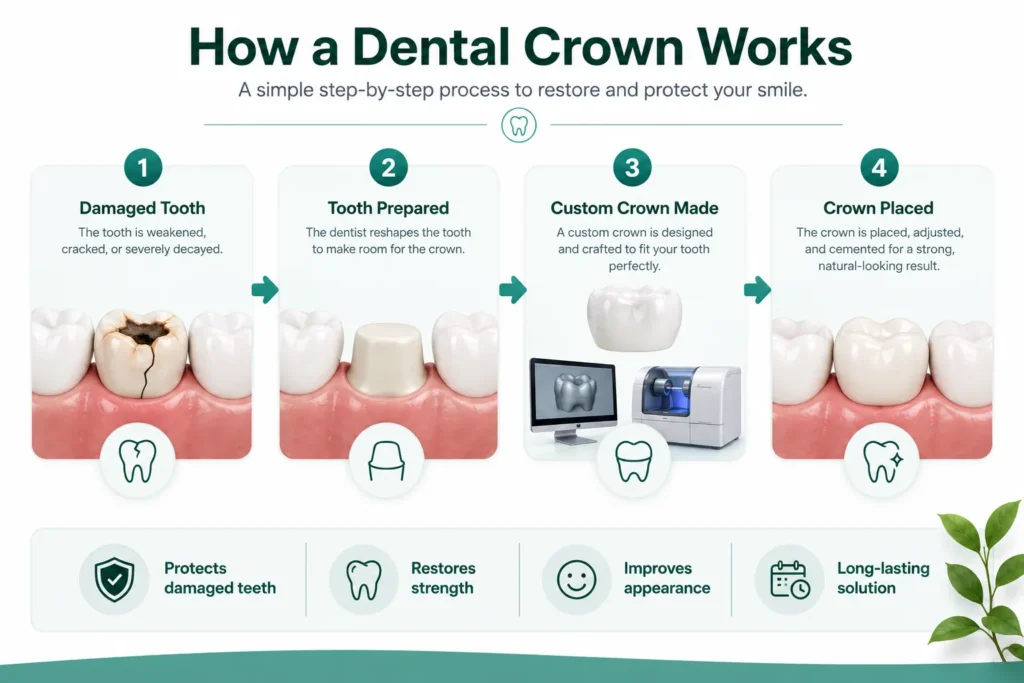
How a Dental Crown Works
This visual overview shows how a dental crown may help protect and restore a damaged tooth, from tooth preparation to final crown placement.
How Dental Insurance Usually Covers Crowns
Dental insurance plans often group dental services into categories.
Preventive care usually includes exams, cleanings, and routine X-rays. Basic care may include smaller restorative procedures. Crowns are usually placed in the major restorative category because they are more complex than a filling and are used to restore a tooth that has already been damaged.
Why Crowns Are Usually Major Restorative Care
A crown is not normally considered preventive care. Preventive care helps stop problems before they develop. A crown treats a problem that already exists, such as a cracked tooth, a tooth weakened by a large filling, or a tooth that needs protection after root canal treatment.
Because crowns are usually major services, dental plans may cover them less generously than cleanings or exams. The ADA explains that dental benefit plans may include deductibles, copayments, coinsurance, annual maximums, and other limitations. (ada.org)
What “Covered” Really Means
If your dental plan says crowns are covered, that usually means the plan may help pay for an eligible crown under certain conditions.
It does not always mean the plan will pay the full cost, cover the crown immediately, approve every crown material, or cover a replacement crown automatically.
Coverage may depend on why the crown is needed, whether it is considered medically necessary, whether your dentist is in network, whether a waiting period applies, how much of your annual maximum remains, and whether the plan has material or replacement limits.
A better question is not simply, “Are crowns covered?”
A better question is:
“Is this specific crown covered for this specific tooth, with this dentist, under my current plan rules?”
When a Crown Is More Likely to Be Covered
Dental insurance is more likely to help pay for a crown when the crown is needed to restore health, strength, or function.
Cracked or Weakened Tooth
A crown may be recommended when a tooth is cracked, weakened, or at risk of breaking further.
If the dentist can show that the tooth needs protection and a simple filling would not be enough, the crown may be more likely to meet the plan’s coverage rules.
Large Filling or Severe Decay
A tooth with a very large filling may not have enough healthy structure left to support another filling.
In that situation, a crown may be recommended to protect the remaining tooth and restore chewing function.
Crown After Root Canal
A crown is sometimes recommended after root canal treatment, especially for back teeth that handle heavy chewing pressure.
However, the root canal and the crown may be treated as separate services by dental insurance. One may be covered differently from the other.
Broken or Failing Old Crown
A replacement crown may be covered if the existing crown is broken, leaking, damaged, or no longer functional.
However, replacement rules can apply. The plan may require documentation showing why the crown needs to be replaced.
When a Crown May Not Be Covered
A crown may not be covered, or may be covered differently, if the plan does not consider it medically necessary.
Cosmetic-Only Crowns
If the crown is mainly for appearance, the plan may not cover it. For example, a crown placed only to change the color, shape, or look of a tooth may be treated differently from a crown needed to protect a damaged tooth.
Premium Materials Beyond the Plan Allowance
Some plans may limit how they pay for certain crown materials.
If you choose a material that costs more than the plan’s standard allowance, the plan may still base payment on the material it considers eligible. This does not mean the material is wrong. It means your plan may not pay more just because a different material was chosen.
The ADA notes that indirect restorative materials differ in composition, strength, esthetics, processing methods, and clinical use, which is why material choice depends on the individual case. (ada.org)
Replacement Crown Too Soon
Replacement crowns may be subject to frequency limits.
A plan may not pay for a new crown if the existing crown was placed too recently under that plan’s rules, unless there is a clear reason for replacement.
If your dentist is out of network, the plan may pay less or may not cover the crown the same way.
Out-of-Network or Undocumented Treatment
Documentation also matters. Insurance may require X-rays, photos, chart notes, or a written explanation showing why the crown is needed.
What Costs and Rules Can Still Apply?
Even when a crown is covered, several plan rules can affect your out-of-pocket cost.
Deductible
A deductible is the amount you may need to pay before the plan starts sharing the cost of certain services. Some plans apply deductibles to major care, including crowns.
Coinsurance or Copay
Coinsurance means you pay part of the approved cost and the plan pays part. A copay is a set amount you pay for a covered service.
Your plan may use one of these methods depending on the type of dental coverage you have.
Annual Maximum
An annual maximum is the most your plan will pay for covered dental care during a benefit year. Crowns can use a significant portion of a dental plan’s yearly benefit. If you already used benefits earlier in the year, less may remain for the crown.
The ADA describes annual maximums as a common dental plan limitation and explains that plans may reimburse only up to a set amount during a plan year. (ada.org)
Waiting Period
A waiting period is the time you must wait after your plan starts before certain services are covered. Because crowns are often major services, they may be subject to a waiting period.
HealthCare.gov explains that if a stand-alone dental plan has a waiting period, the plan will not cover affected services until the waiting period ends, even though premiums are still due during that time. (healthcare.gov)
For a broader explanation, review our How Waiting Periods Work in Dental Coverage guide.
Network Rules
Many dental plans pay more predictably when you use an in-network dentist. If you use an out-of-network dentist, your share may be higher, or the plan may calculate payment differently.
Material Limitations
Some plans may cover a crown but limit how much they pay based on the crown material.
This is especially important for front teeth, back teeth, and situations where appearance and strength both matter.
Does Insurance Cover Crown Replacement?
Dental insurance may cover replacement crowns, but replacement rules often apply. A plan may ask why the existing crown needs to be replaced. Common reasons may include fracture, decay around the crown, poor fit, open margins, or failure of the crown.
If the replacement is mainly for appearance, or if the existing crown has not met the plan’s replacement timing rule, coverage may be limited or denied.
Ask your dentist to document why the replacement is needed and ask your insurer whether any replacement limit applies.
Does Insurance Cover a Crown After a Root Canal?
Dental insurance may cover a crown after a root canal if the crown is considered necessary to protect the tooth. However, the root canal and crown are usually separate procedures. They may fall under different benefit categories, have different coverage rules, or be affected differently by the annual maximum.
Before treatment begins, ask whether the root canal, buildup, temporary crown, final crown, and any related services are covered separately.
Does Medicare Cover Dental Crowns?
Original Medicare generally does not cover routine dental care or most dental procedures done primarily for oral health.
Some Medicare Advantage plans may include dental benefits, but coverage varies by plan. If you have Medicare Advantage, check your plan documents before assuming crowns are covered.
How to Check Your Crown Coverage Before Treatment
Before getting a crown, take time to verify the details.
Ask for the Procedure Code
Ask your dentist for the procedure code and a written treatment plan. This helps the insurance company review the exact service being recommended.
Request a Pre-Treatment Estimate
A pre-treatment estimate, sometimes called a predetermination or pre-authorization, allows the plan to review the proposed crown before treatment begins. The ADA explains that pre-authorization or predetermination can be used by plans to review proposed treatment, although eligibility and final payment still depend on the plan rules at the time of service. (ada.org)
Confirm the Waiting Period
Ask whether major restorative services are currently covered under your plan or still in a waiting period.
Check the Annual Maximum
Ask how much of your annual maximum is still available. This matters if you already used benefits for exams, fillings, periodontal care, or other procedures earlier in the year.
Ask Whether Material Affects Coverage
Ask whether your plan treats porcelain, ceramic, zirconia, metal, or porcelain-fused-to-metal crowns differently. Also ask whether the plan uses an alternate benefit rule or material allowance.
Confirm the Dentist Network
Ask whether your dentist is in network for your exact plan. Do not rely only on a general provider directory. Confirm directly with the dental office and the insurer.
What If Insurance Does Not Cover Enough?
Dental insurance may reduce the cost of a crown, but it may not cover the full amount. If your plan does not cover enough, compare your options before delaying care.
Ask for a Written Estimate
Ask the dental office for a written estimate showing the expected insurance portion and your estimated out-of-pocket share. This helps you understand the decision before treatment begins.
Compare In-Network Dentists
If you are not attached to one provider, an in-network dentist may reduce your cost. Make sure the dentist is in network for your exact plan, not just the same insurance company.
Discuss Crown Material Options
Ask your dentist whether different crown materials are clinically appropriate for your tooth. Do not choose material based only on insurance. Strength, location, bite pressure, and appearance all matter.
Use HSA or FSA Funds When Available
Health Savings Account or Flexible Spending Account funds may help pay for eligible dental expenses. These accounts do not change your insurance coverage, but they may make out-of-pocket costs easier to manage.
Ask About Payment Plans
Some dental offices offer payment plans or third-party financing. Before agreeing, review the terms carefully, including payment timing, fees, interest rules, and what happens if payments are late.
Consider a Dental Savings Plan
A dental savings plan is not insurance. It is a membership program that may provide discounted fees from participating dentists. This may help if insurance does not cover enough, if a waiting period applies, or if the service is excluded.
For a broader comparison, read our Dental Insurance vs Dental Savings Plans guide.
Check Dental Schools or Community Clinics
Dental schools and community clinics may provide lower-cost dental care or referrals. Availability, wait times, and services vary by location.
Ask Whether Treatment Can Be Phased Safely
Sometimes treatment can be planned in stages. However, a weak or cracked tooth may become worse if treatment is delayed. Ask your dentist what can safely wait and what should not be postponed.
Questions to Ask Before Getting a Crown
| Question | Why it matters |
|---|---|
| Is the crown medically necessary? | Insurance usually cares about function, not just appearance |
| Is the crown classified as major care? | Major services often have stricter rules |
| Is there a waiting period? | Coverage may not be available right away |
| Has my deductible been met? | This can affect what I pay |
| How much annual maximum remains? | The plan may have limited benefit left |
| Is my dentist in network? | Network status can change out-of-pocket cost |
| Does crown material affect coverage? | Some plans limit payment by material type |
| Is this a replacement crown? | Replacement limits may apply |
| Is pre-treatment estimate recommended? | It can reduce surprise bills |
| Are related services billed separately? | Root canals, buildups, and crowns may have separate rules |
Our Recommendation
Dental insurance may cover crowns, but you should verify the details before treatment.
Start by asking why the crown is needed. If the crown is medically necessary to restore or protect the tooth, it is more likely to fit the plan’s coverage rules.
Then check the practical details: waiting period, deductible, coinsurance, annual maximum, network status, crown material, and replacement limits.
If coverage is limited, ask for a written estimate and compare your options. Dental insurance may help, but it should not be the only factor in deciding whether to treat a damaged tooth.
The goal is not just to find out whether crowns are “covered.” The goal is to understand how much the plan may help, what rules apply, and whether waiting could make the dental problem worse.
When you are ready to review options, compare dental plans by looking at major restorative coverage, waiting periods, annual maximums, deductibles, coinsurance, material rules and dentist networks.
Helpful Resources
- Dental Plans Guide
- Dental Insurance Coverage for Common Procedures
- Does Dental Insurance Cover Dentures?
- Does Dental Insurance Cover Implants?
- How Waiting Periods Work in Dental Coverage
- No Waiting Period Dental Insurance
- Dental Insurance vs Dental Savings Plans
- Compare Dental Plans
- Dental Insurance Learning Center
🔥Our Editorial Standards
Dental Coverage Hub is committed to providing clear, educational and regularly reviewed information about dental plans and dental insurance.
Sources
- MouthHealthy / American Dental Association — Crowns
American Dental Association — An Introduction to Dental Benefits
American Dental Association — Typical Dental Plan Benefits and Limitations
American Dental Association — Materials for Indirect Restorations
American Dental Association — Pre-Authorizations
HealthCare.gov — Dental Coverage in the Marketplace
Medicare.gov — Dental Services
CMS — Medicare Dental Coverage
Frequently Asked Questions
Does dental insurance cover crowns?
Dental insurance may cover crowns, especially when they are medically necessary to restore or protect a damaged tooth.
Coverage depends on your plan’s rules, waiting periods, annual maximum, dentist network, and the reason for the crown.
Are crowns considered major dental care?
Yes, crowns are usually considered major restorative care.
That means they may be covered differently from preventive services such as cleanings and exams.
Does insurance cover crowns after a root canal?
Dental insurance may cover a crown after a root canal if the crown is needed to protect the tooth.
However, the root canal and crown may be billed and covered separately.
Are cosmetic crowns covered by dental insurance?
Cosmetic crowns are often not covered the same way as medically necessary crowns.
If the main reason is appearance rather than restoring tooth structure or function, coverage may be limited or denied.
Does dental insurance cover replacement crowns?
Dental insurance may cover replacement crowns, but replacement limits often apply.
The plan may require the existing crown to meet certain timing rules or require documentation showing why replacement is necessary.
Does crown material affect insurance coverage?
Yes, it can.
Some plans may pay based on the material they consider standard or eligible for the tooth. If you choose a different material, your out-of-pocket cost may be higher.
Can a crown be denied by insurance?
Yes. A crown may be denied if the plan does not consider it medically necessary, if documentation is missing, if a waiting period applies, if the crown is cosmetic, or if replacement rules are not met.
Should I get a pre-treatment estimate for a crown?
Yes, it is usually a good idea.
A pre-treatment estimate can help you understand how your plan may handle the crown before treatment begins.
What should I do if insurance does not cover enough?
Ask for a written estimate, confirm network status, discuss material options, ask about payment plans, consider HSA or FSA funds when available, and compare dental savings plans or lower-cost care options.
Last reviewed: July 2026
About the Author: M.D.-Content creator and researcher focused on helping consumers better understand dental plans, coverage options and dental insurance concepts.
Reviewed by Dental Coverage Hub Editorial Team. Content is reviewed regularly to help ensure information remains accurate, practical and useful for consumers exploring dental coverage options in the United States.
✅ This article is intended for educational purposes only and should not be considered insurance, financial or legal advice.

Compare Dental Plans With Confidence
Crown coverage can vary by plan. Compare waiting periods, annual maximums, deductibles, coinsurance, material rules and dentist networks before starting treatment.