
🦷 Retirement Dental Coverage
🇺🇸 Information for U.S. Consumers
✓ Plan Comparison Guidance

Dental Insurance for Retirees: What to Compare After Retirement
Compare former-employer or union benefits, COBRA, spouse coverage, Medicare Advantage dental benefits, directly purchased plans, Medicaid, provider networks, waiting periods, and expected costs.
Written and researched by Maria Dumitru.
Founder and Content Editor at Dental Coverage Hub
Last reviewed: August 2026
What You’ll Learn
Retirement can change how a person obtains dental coverage, but it does not create one specific type of dental plan.
Some retirees leave an employer dental plan before becoming eligible for Medicare. Others may have retiree benefits from a former employer or union, qualify for coverage through a spouse, continue selected benefits through COBRA, purchase dental insurance directly, or compare Marketplace dental options while purchasing Marketplace health coverage.
Medicare-eligible retirees may instead compare retiree dental benefits, dental coverage included in a Medicare Advantage plan, directly purchased dental insurance, Medicaid benefits when eligible, or noninsurance payment arrangements.
These options use different eligibility rules, premiums, provider networks, effective dates, waiting periods, benefit limits, exclusions, and renewal terms.
This guide explains how to identify the coverage source, verify dentists and specialists, review expected treatment, compare written benefits, and estimate the total amount the retiree may pay.
For broader guidance based on age, household, employment, or retirement status, review Dental Insurance for Different Life Stages and Work Situations.
Original Medicare’s limited dental coverage, Marketplace enrollment rules and state-specific Medicaid adult benefits support the need to evaluate each coverage source separately.
Quick Answer
Dental coverage after retirement may come from several sources, depending on eligibility and location.
Possible options include:
- Retiree dental benefits from a former employer, union, or retirement system
- COBRA or another continuation arrangement when available
- Coverage through a spouse’s current employer plan
- Dental insurance purchased directly
- Dental benefits included in a Marketplace health plan
- A separate Marketplace dental plan purchased with Marketplace health coverage
- Dental benefits included in a Medicare Advantage plan
- Medicaid adult dental benefits when available
- A dental savings plan
- A dental office membership program
- Direct payment or another payment arrangement
These options are not interchangeable.
Before enrolling, confirm:
- The exact product and coverage source
- Who is eligible
- The effective date
- The complete premium or membership cost
- Whether another employer contributes
- The dentist and specialist networks
- Deductibles, copays, coinsurance, or scheduled member charges
- Annual or other benefit limits
- Waiting periods
- Treatment-in-progress provisions
- Denture, crown, implant, periodontal, and oral-surgery benefits
- Renewal, cancellation, and continuation rules
- The estimated total cost for expected care
Original Medicare should not be treated as ordinary dental insurance. It does not cover most routine dental services, dentures, or implants, although limited dental services may qualify when directly connected to specified covered medical treatment.
Key Takeaways
- Retirement status and Medicare eligibility are separate questions
- Dental coverage does not begin automatically when employment ends
- Original Medicare does not provide a general routine dental benefit
- Medicare Advantage dental benefits depend on the specific plan and may use separate networks, limits, prior-authorization rules, and member charges
- COBRA may continue an existing dental benefit when the plan and qualifying event are eligible, but it does not automatically postpone Medicare enrollment deadlines
- Retiree and spouse coverage depend on the applicable plan’s eligibility and enrollment rules
- A directly purchased dental policy and a separate Marketplace dental plan are different enrollment arrangements
- Adult Medicaid dental benefits, covered procedures, providers, and limitations vary by state
- Dental savings plans and office membership programs are not dental insurance
- Compare the complete written terms and expected costs rather than only the monthly premium
Medicare, Department of Labor, HealthCare.gov and Medicaid guidance confirm these distinctions among Original Medicare, Medicare Advantage, COBRA, Marketplace dental coverage and adult Medicaid benefits.
In This Guide
Retirement Status and Medicare Eligibility Are Different
For this guide, retirement status describes a change in work or employer-sponsored benefits.
Medicare eligibility is a separate coverage question.
A person may:
- Retire before becoming eligible for Medicare
- Become eligible for Medicare while continuing to work
- Receive Medicare before the usual retirement age because of a qualifying condition
- Retire while remaining covered through a spouse
- Have retiree benefits that work alongside Medicare
- Have Medicare without any separate routine dental benefit
The dental comparison should therefore begin with the retiree’s actual coverage sources rather than age or retirement status alone.
Retirees Who Are Not Yet Medicare-Eligible
Possible coverage sources may include:
- Former-employer or union retiree dental benefits
- COBRA or another continuation arrangement
- Coverage through a spouse’s current employer
- Directly purchased individual or family dental insurance
- Dental benefits included in Marketplace health coverage
- A separate Marketplace dental plan purchased with Marketplace health coverage
- Medicaid when eligible
- Noninsurance payment arrangements
Marketplace dental coverage must be evaluated together with the applicable health-plan enrollment rules. A separate Marketplace dental plan generally cannot be purchased through the federal Marketplace unless a Marketplace health plan is being purchased at the same time.
Medicare-Eligible Retirees
Possible dental coverage sources may include:
- Former-employer or union retiree dental benefits
- A spouse’s current employer dental plan
- Dental benefits included in a Medicare Advantage plan
- Directly purchased dental insurance
- Medicaid adult dental benefits when eligible
- A dental savings plan
- A dental office membership program
- Direct payment or another payment arrangement
Original Medicare generally does not cover routine dental care, dentures, or implants. Medicare Advantage plans may offer additional dental benefits, but each plan can use different provider, authorization, cost and service rules.
For broader age-related coverage guidance, review Best Dental Insurance for Seniors: What to Compare Before You Enroll.
Why Dental Coverage Changes After Retirement
Dental coverage often changes when work changes. Many people receive dental benefits through an employer. When they retire, that coverage may end, change, become more expensive, or require a separate decision.
Losing Employer-Sponsored Dental Benefits
Some retirees lose dental coverage when they leave work. Others may be offered retiree dental benefits, COBRA, or temporary continuation coverage. Some may be able to join a spouse’s plan if the spouse is still working.
The important point is that retirement does not automatically create dental coverage.
Why Original Medicare Usually Does Not Replace Dental Insurance
Original Medicare helps with many medical needs, but routine dental care is usually outside its coverage.
Medicare.gov states that, in most cases, Medicare does not cover routine cleanings, fillings, tooth extractions, dentures, or implants. That means retirees may need a separate dental coverage strategy.
Why Dental Needs May Increase After Retirement
Dental needs may change with age. The CDC explains that oral health problems can increase with age because of saliva changes, receding gums, difficulty brushing or flossing, chronic disease, cognitive problems, and physical limitations.
Retirees may need more than routine cleanings. They may need help planning for gum care, crowns, dentures, implants, root canals, extractions, or emergency visits.
Dental Coverage Sources Retirees Can Compare
| Coverage source | What it generally represents | What to verify |
|---|---|---|
| Former-employer or union retiree dental benefit | Dental coverage offered after active employment ends | Eligibility, retiree premium, spouse coverage, network, benefit changes, Medicare-related rules, renewal terms |
| COBRA or continuation coverage | Temporary continuation of an eligible former group dental benefit | Whether dental is included, COBRA eligibility, election deadline, premium, duration, network, treatment already in progress |
| Spouse’s current employer plan | Dependent enrollment through an actively employed spouse | Dependent eligibility, enrollment period, employer contribution, effective date, provider network, waiting periods |
| Directly purchased dental insurance | Individual or family dental policy purchased outside an employer plan | Insurer, policy, network, effective date, premium, deductibles, waiting periods, benefit limits, exclusions |
| Marketplace dental option | Dental benefits included in a Marketplace health plan or offered through a separate Marketplace dental plan | Simultaneous health-plan enrollment, separate premium, adult waiting periods, provider network, covered services |
| Medicare Advantage dental benefit | Supplemental dental benefit offered through a particular Medicare Advantage plan | Evidence of Coverage, dental administrator, network, prior authorization, service list, allowance or maximum, copays |
| Medicaid adult dental benefit | State-defined dental benefit for eligible adult Medicaid members | State eligibility, services, participating providers, authorization requirements, limits, managed-care rules |
| Dental savings plan | Discount membership rather than insurance | Exact participating providers, written fees, activation date, membership charges, exclusions, cancellation |
| Dental office membership program | Written payment arrangement with a particular dental office | Included services, office location, discounts, specialist rules, renewal and cancellation |
| Direct payment or financing | Payment to the dental office without an insurance benefit | Written treatment estimate, interest, fees, payment schedule, refund and cancellation terms |
Adult Medicaid dental benefits are optional at the federal level, and Marketplace, COBRA and Medicare Advantage options each follow distinct eligibility and plan rules.
Important Medicare Timing Note
COBRA continuation and Medicare enrollment are separate decisions.
Medicare states that the Special Enrollment Period for Part B begins when current employment or active job-based coverage ends, even when COBRA is elected.
A retiree should verify Medicare enrollment deadlines separately from the decision to continue dental or medical benefits through COBRA.
How to Compare Dental Coverage After Retirement
Step 1: Identify Every Available Coverage Source
List every dental option for which the retiree may be eligible:
- Former-employer, union, or retirement-system dental benefits
- COBRA or another continuation arrangement
- Coverage through a spouse’s current employer
- Dental insurance purchased directly
- Marketplace dental coverage when applicable
- Dental benefits included in a Medicare Advantage plan
- Medicaid adult dental benefits when eligible
- A dental savings plan
- A dental office membership program
- Direct payment or another payment arrangement
Do not compare the options until the product type, eligibility rules, effective date, and responsible insurer or administrator are understood.
Step 2: Identify Everyone Who Needs Coverage
Record whether coverage is needed for:
- One retiree
- A spouse
- A domestic partner when eligible
- An eligible dependent
- Another household member with separate coverage options
For each person, identify:
- Current dentists
- Specialists
- Treatment already recommended
- Treatment already started
- Existing dentures, crowns, bridges, or implants
- Expected maintenance or replacement care
- Other available dental coverage
Retirement status alone does not determine the dental services a person will need.
Step 3: Compare the Complete Fixed Cost
Include:
- Monthly or annual premiums
- Spouse or dependent premiums
- Retiree contributions
- Membership fees
- Enrollment or administrative charges
- Any former-employer or current-employer contribution
- The complete cost for the same comparison period
Do not compare one monthly premium with an annual membership fee or with the price of a single dental visit.
For a complete explanation of dental-plan expenses, review Dental Insurance Costs Explained.
Step 4: Verify Dentists and Specialists
Confirm the exact:
- Dentist or specialist
- Office location
- Plan
- Network
- Current participation
- New-patient availability
Depending on the expected care, check:
- General dentists
- Periodontists
- Endodontists
- Oral surgeons
- Prosthodontists
- Denture providers
- Implant providers
A dental office may accept insurance from a company without participating in every plan or network offered by that company.
For more detail, review In-Network vs Out-of-Network Dental Insurance.
Step 5: Review Deductibles and Member Cost Sharing
Confirm:
- The deductible
- Which services are subject to it
- Copays
- Coinsurance
- Scheduled member charges
- The plan allowance
- Out-of-network charges
- Possible balance billing
- Whether different rules apply to preventive, basic, major, or specialist services
A displayed benefit percentage may be applied to the plan allowance rather than the dental office’s complete charge.
Step 6: Review Annual and Other Benefit Limits
Confirm:
- The annual maximum
- How much remains
- Which services reduce it
- When it resets
- Whether preventive services are treated differently
- Whether implants, dentures, periodontal care, or other procedures have separate limits
- Whether orthodontics uses a separate lifetime maximum
- Whether continued enrollment is required for future payments
The annual maximum limits the amount the plan may pay. It does not limit the dental office’s complete treatment charge.
For a fuller explanation, review Dental Insurance Annual Maximums Explained.
Step 7: Review Effective Dates and Waiting Periods
Confirm:
- The coverage effective date
- Waiting periods by service category
- The exact date anticipated treatment becomes eligible
- Whether previous comparable coverage affects a waiting period
- Which documentation is required
- Whether the decision will be provided in writing
A plan can be active while selected services remain ineligible.
For more detail, review How Waiting Periods Work in Dental Coverage.
Step 8: Review Contract Limitations
Look for:
- Treatment-in-progress provisions
- Missing-tooth provisions
- Frequency limits
- Crown, denture, bridge, or appliance replacement limits
- Implant exclusions
- Alternate-benefit provisions
- Prior-authorization requirements
- Referral requirements
- Cosmetic-service exclusions
- Out-of-network limitations
A procedure may appear in a covered category and still be ineligible because another contract rule applies.
Step 9: Review the Official Documents
Use the applicable:
- Evidence of Coverage
- Policy or certificate of coverage
- Schedule of benefits
- Provider directory
- Exclusions and limitations
- Retiree enrollment materials
- Summary Plan Description
- Medicare Advantage dental-benefit section
- Medicaid member handbook
- Member-charge or discount-fee schedule
- COBRA election materials
Marketing summaries may omit provider, eligibility, authorization, benefit-limit, and exclusion rules.
Match the Coverage Comparison to Expected Dental Care
Begin with the retiree’s current dental condition and written treatment recommendations rather than making assumptions based on age.
Diagnostic and Preventive Services
Verify:
- Examinations
- Cleanings
- X-rays
- Frequency limits
- Dentist-network requirements
- Deductible treatment
- Whether the services reduce an annual maximum
Do not assume that every diagnostic or preventive service is covered without limits.
Periodontal Care
Periodontal services may include:
- Periodontal evaluations
- Scaling and root planing
- Periodontal maintenance
- Gum surgery
- Specialist consultations
Confirm procedure classifications, frequency limits, waiting periods, specialist networks, deductibles, and annual-maximum treatment.
Root Canal Treatment
Root canal treatment should be reviewed as a separate endodontic benefit rather than assumed to follow the same rules as the restoration placed afterward.
Confirm:
- The exact endodontic procedure
- How the plan classifies the treatment
- Any applicable waiting period
- Deductible and cost-sharing
- Whether the dentist or endodontist participates in the required network
- Remaining annual benefits
- Treatment-in-progress provisions when relevant
- Whether predetermination or authorization is recommended
- How the filling, core buildup, crown, or other final restoration will be evaluated
A referral from a general dentist does not automatically confirm that the endodontist participates in the same network.
For root-canal-specific guidance, review Does Dental Insurance Cover Root Canals?
If a filling is expected afterward, review Does Dental Insurance Cover Fillings?
Crowns
A crown may be part of a larger treatment plan, including treatment following a root canal, but the crown should be verified separately.
Confirm:
- The applicable benefit classification
- Waiting periods
- Deductible and cost-sharing
- Provider-network rules
- Crown replacement limitations
- Material or alternate-benefit provisions
- Treatment-in-progress rules
- Remaining annual benefits
- Predetermination or authorization requirements
Coverage for another procedure does not automatically establish coverage for the crown.
For crown-specific guidance, review Does Dental Insurance Cover Crowns?
Dental Bridges
Dental bridge treatment may involve several separately relevant insurance questions.
Confirm:
- The specific bridge being proposed
- Which teeth are being replaced
- Supporting crowns or retainers
- Missing-tooth or initial-placement provisions
- Waiting periods
- Deductible and cost-sharing
- Provider-network requirements
- Replacement limitations
- Alternate-benefit provisions
- Remaining annual benefits
If the tooth was already missing before the current coverage began, review any missing-tooth provision separately from the waiting period.
Coverage for one bridge component does not automatically establish coverage for every related service.
For bridge-specific guidance, review Dental Insurance for Bridges.
Dentures
Denture treatment may involve more than the initial appliance.
Verify:
- Complete or partial dentures
- Extractions
- Temporary dentures
- Adjustments
- Repairs
- Relines
- Rebases
- Replacement intervals
- Missing-tooth provisions
- Provider-network requirements
For a detailed explanation, review Does Dental Insurance Cover Dentures?.
Dental Implants
Implant treatment may involve separately evaluated services, including:
- Diagnostic imaging
- Extraction
- Bone grafting
- Implant-body placement
- Abutment placement
- Implant crown
- Implant-supported bridge or denture
- Follow-up care
Coverage of one component does not establish coverage of the complete treatment.
For more detail, review Does Dental Insurance Cover Implants?.
Extractions and Oral Surgery
Confirm:
- Whether the extraction is simple or surgical
- The treating provider
- Specialist-network requirements
- Deductible and cost sharing
- Waiting periods
- Authorization requirements
- Whether the extraction is connected to dentures, implants, or another treatment plan
Extraction coverage should be verified separately from any later treatment used to replace the missing tooth. A bridge, implant, or denture may have its own eligibility requirements, waiting periods, provider-network rules, and other limitations.
For extraction-specific guidance, review Does Dental Insurance Cover Tooth Extraction?
Emergency Dental Care
Review how the plan handles:
- Emergency examinations
- Pain relief
- Infection treatment
- Extractions
- Out-of-area care
- Out-of-network emergencies
- Specialist treatment
- Follow-up services
An emergency provision may address immediate treatment without covering every later restorative procedure.
Existing Dental Work
A retiree with existing crowns, dentures, bridges, or implants should also review:
- Maintenance services
- Repair benefits
- Replacement intervals
- The original placement date
- Documentation requirements
- Provider-network rules
- Exclusions for appliances placed before enrollment
Dental Insurance and Noninsurance Arrangements Are Different
Dental Insurance
Dental insurance may pay part of eligible covered services according to the policy.
It may use:
- Premiums
- Deductibles
- Copays or coinsurance
- Provider networks
- Plan allowances
- Waiting periods
- Annual maximums
- Covered-service categories
- Exclusions
The insurer or plan administrator processes benefits according to the contract.
Dental Savings Plans
A dental savings plan is a discount membership, not insurance.
The program generally does not pay claims. The member pays the dental office according to the written discounted-fee arrangement.
Before joining, confirm:
- The exact dentist and office location
- Specialist participation
- Written fees for anticipated procedures
- The activation date
- Membership and administrative charges
- Exclusions
- Renewal and cancellation rules
- Whether treatment already scheduled or started qualifies
Do not rely only on an advertised discount percentage or an online provider directory.
Dental Office Membership Programs
A dental office membership program is generally an arrangement between a patient and a particular dental office.
Confirm:
- The office where the program can be used
- Services included
- Visit limits
- Discounts for additional treatment
- Specialist arrangements
- Excluded services
- Renewal rules
- Cancellation terms
- What happens if the patient changes providers
Compare the Complete Terms
Do not ask whether insurance or a savings plan is universally better.
Compare:
- Fixed premiums or membership fees
- Participating providers
- Written procedure charges
- Insurance benefits
- Discounts
- Waiting or activation rules
- Exclusions
- Cancellation terms
- Expected total costs
For a detailed comparison, review Dental Insurance vs Dental Savings Plans.
Dental Coverage Sources After Retirement
A visual summary of former-employer benefits, COBRA, spouse coverage, directly purchased dental insurance, Medicare Advantage dental benefits, Medicaid, and noninsurance payment arrangements.
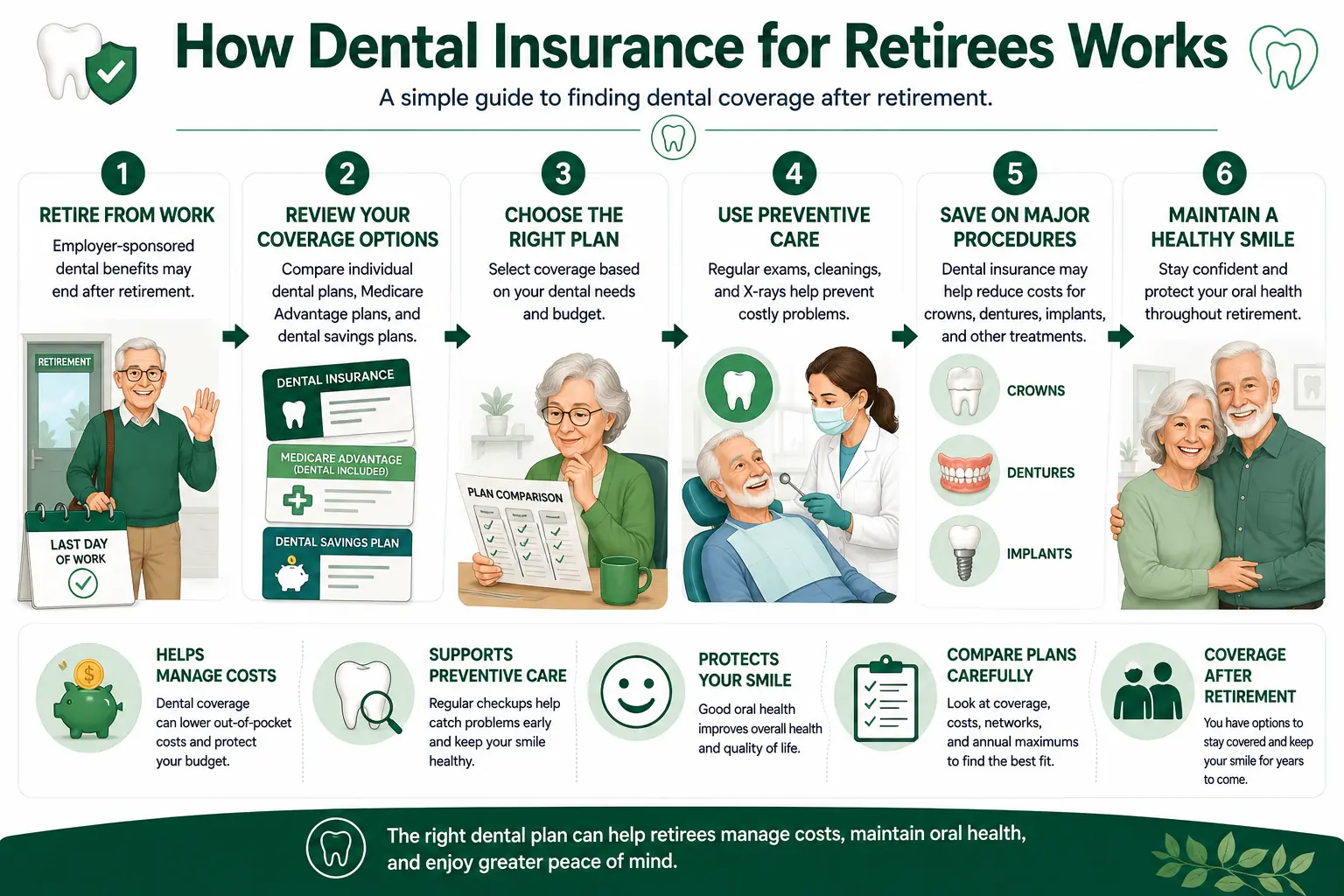
Important to Know:
- Retirement does not automatically create dental coverage
- Original Medicare does not provide a general routine dental benefit
- Medicare Advantage dental benefits vary by plan
- COBRA, retiree benefits, spouse coverage, direct insurance, and Medicaid use different eligibility rules
- Verify the exact product, provider network, treatment benefits, limits, and complete costs
What to Do When Dental Treatment Is Needed Soon
Obtain a Written Treatment Plan
Ask the dental office for:
- The diagnosis
- Each proposed procedure
- CDT codes
- Treating providers
- Office locations
- Estimated charges
- Proposed treatment dates
- Treatment already completed or started
For multistage care, ask the office to list each service separately.
Confirm the Coverage Effective Date
Do not assume that:
- The application date is the effective date
- The first premium payment immediately activates every benefit
- COBRA election automatically prevents a coverage gap
- Previous employer coverage automatically removes a waiting period
- Medicare eligibility activates a routine dental benefit
Ask for the effective date in writing.
Verify Every Procedure
For each procedure, confirm:
- Covered-service status
- Classification
- Deductible
- Copay or coinsurance
- Plan allowance
- Waiting period
- Provider network
- Annual maximum
- Replacement rules
- Missing-tooth provisions
- Treatment-in-progress provisions
- Alternate benefits
- Authorization requirements
Distinguish Preauthorization From Predetermination
A plan may require preauthorization before selected treatment begins.
A predetermination or pretreatment estimate may instead provide an advance estimate of potential benefits.
Ask:
- Which process applies
- Whether it is required or optional
- Which records must be submitted
- How long the response remains valid
- Whether a new review is needed if treatment changes
Neither process necessarily guarantees final payment.
Eligibility, provider participation, remaining benefits, continued enrollment, and treatment details can change before the claim is processed.
Estimate the Complete Patient Responsibility
Ask the dental office to identify:
- The complete treatment charge
- The plan allowance
- Deductible
- Copay or coinsurance
- Expected plan payment
- Noncovered services
- Amounts above the annual maximum
- Out-of-network amounts
- Estimated patient responsibility
The result remains an estimate rather than a guaranteed final bill.
HSA, FSA, and HRA Considerations After Retirement
This section provides general educational information and is not tax advice.
Existing HSA Funds
Existing HSA funds may generally remain in the account after retirement and can be distributed for qualified medical expenses under the applicable rules.
However, beginning with the first month a person is enrolled in Medicare, the HSA contribution limit becomes zero. Retroactive Medicare coverage can also affect contributions made for earlier months.
Confirm:
- The Medicare effective date
- Whether Medicare enrollment will be retroactive
- The final month for an eligible HSA contribution
- Whether the dental expense qualifies
- Whether another source paid or reimbursed the expense
- Required records
Review the current IRS Publication 969 and consult a qualified tax professional or account administrator.
Health FSA
A health FSA is generally connected to an employer plan.
After retirement or employment termination, access can depend on:
- The employer plan
- The date the expense was incurred
- Remaining account funds
- COBRA eligibility for the health FSA
- Grace-period or carryover provisions
- Claim-submission deadlines
Confirm the rules with the employer or account administrator.
HRA
An HRA is funded and controlled according to the employer plan.
Eligibility after retirement, reimbursable dental expenses, available balances, Medicare coordination, and claim procedures depend on the applicable HRA terms.
Avoid Duplicate Reimbursement
Do not use tax-free account funds for an expense already reimbursed by insurance or another source.
Keep invoices, Explanation of Benefits documents, account statements, and payment records.
IRS states that HSA distributions used for qualified medical expenses may be tax-free when the expense was not otherwise compensated, and records must support the distribution.
Comparing Dental Coverage for Retired Couples
Two retired spouses may have different:
- Medicare status
- Employer or retiree benefits
- Medicaid eligibility
- Dentists and specialists
- Treatment needs
- Existing dental work
- Provider networks
- Waiting periods
- Benefit limits
Compare:
- One shared dental policy
- Separate directly purchased policies
- Retiree benefits for one or both spouses
- Coverage through one spouse’s current employer
- Medicare Advantage dental benefits for either spouse
- Medicaid benefits when eligible
- Noninsurance payment arrangements
One shared arrangement may simplify administration, but it does not automatically provide suitable providers, benefits, or total costs for both people.
Separate arrangements may provide different networks or benefits but can also involve:
- Multiple premiums
- Separate deductibles
- Different effective dates
- Different provider directories
- Multiple claim procedures
- Coordination-of-benefits questions
When one person has more than one dental plan, confirm which plan is primary, whether the second plan coordinates, and which Explanation of Benefits documents must be submitted.
For a complete household comparison, review Individual vs Family Dental Plans.
Other Ways to Manage Dental Costs
Limited dental benefits do not establish that a particular alternative treatment or payment arrangement is clinically appropriate.
Begin with the written treatment plan and complete cost estimate.
Community Health Centers
Some community health centers provide dental services, but availability, eligibility, fees, appointment times, and procedures vary by location.
Confirm:
- Which dental services are offered
- Eligibility requirements
- Fee structure
- Appointment availability
- Specialist referrals
- Whether ongoing treatment can be accepted
Dental and Dental Hygiene Schools
Dental or dental hygiene schools may provide selected supervised services.
Confirm:
- Services offered
- Provider supervision
- Appointment frequency
- Expected treatment timeline
- Complete fees
- Whether specialist care is available
- Whether treatment already started can be transferred
Do not assume that every school provides dentures, implants, oral surgery, or complex restorative care.
Nonprofit and Community Programs
Eligibility, covered services, funding, waiting lists, and geographic availability vary.
Obtain the current program terms directly from the responsible organization.
Dental Office Payment Plans
Before agreeing to an office payment plan, review:
- Initial payment
- Installments
- Interest
- Administrative fees
- Late-payment terms
- Automatic-payment requirements
- Cancellation and refund rules
- What happens if treatment changes or stops
A payment plan changes the timing of payment. It does not necessarily reduce the treatment price.
Third-Party Financing
Third-party financing is not dental insurance.
Review:
- Amount financed
- Interest rate
- Deferred-interest conditions
- Fees
- Repayment period
- Total amount due
- Late-payment consequences
- Refund procedures when treatment changes
Phased Treatment
Ask the dental professional whether treatment can be completed safely in stages.
Confirm:
- Which services are urgent
- Which services may be delayed
- The clinical consequences of delay
- Temporary treatment needs
- Whether phasing changes the total cost
- How future insurance benefit periods may apply
Do not postpone urgent or necessary dental care solely to obtain future insurance benefits.
Comparison Errors to Avoid
Treating Retirement and Medicare Eligibility as the Same Event
A person may retire before or after becoming Medicare-eligible.
Compare the actual coverage sources and dates.
Treating Original Medicare as Routine Dental Insurance
Original Medicare does not provide a general routine dental benefit. It covers only limited dental services connected to specified covered medical care.
Assuming Every Medicare Advantage Plan Has the Same Dental Benefits
Dental networks, covered services, authorizations, limits, and member charges depend on the specific plan.
Allowing COBRA to Delay Medicare Enrollment Review
COBRA does not extend the limited period for enrolling in Medicare Part B. Medicare advises eligible people not to wait until COBRA ends before reviewing enrollment.
Assuming Former-Employer or Spouse Coverage Is Automatically Available
Eligibility, premiums, enrollment periods, dependent definitions, and effective dates depend on the applicable plan.
Choosing Only by Premium
A low premium does not reveal provider access, waiting periods, annual maximums, exclusions, or expected patient costs.
Assuming a General Procedure Category Guarantees Payment
A crown, denture, implant, periodontal procedure, or extraction may still be limited by another contract provision.
Treating a Discount Membership as Dental Insurance
Confirm the exact product type, provider participation, written fees, activation date, and cancellation rules.
Continuing HSA Contributions After Medicare Enrollment
The HSA contribution limit becomes zero beginning with the first month of Medicare enrollment, including applicable retroactive coverage periods.
How to Interpret the Retiree Dental Coverage Comparison
Dental coverage after retirement should be evaluated according to the retiree’s actual eligibility, providers, expected treatment, benefit rules, and complete costs.
No coverage source is automatically suitable merely because it is offered by a former employer, included in a Medicare Advantage plan, available through a spouse, or marketed specifically to retirees.
Former-employer or union coverage may deserve closer consideration when:
- The retiree remains eligible
- The premium and contribution structure are understood
- Current dentists and specialists participate
- The anticipated services are included
- Benefit changes after Medicare eligibility are understood
- Spouse or dependent rules fit the household
- Renewal and termination provisions are acceptable
COBRA may deserve closer consideration when:
- The former dental benefit qualifies for continuation
- Maintaining the existing network is important
- Treatment is already planned or in progress
- The complete COBRA premium is manageable
- The temporary coverage period is understood
- Medicare enrollment deadlines are reviewed separately
Coverage through a spouse’s employer may deserve closer consideration when:
- The retiree satisfies the dependent-eligibility rules
- Enrollment is available
- The dependent premium is reasonable
- The provider network is suitable
- Waiting periods and treatment-in-progress rules are understood
- The employer contribution materially reduces the household cost
A Medicare Advantage dental benefit may deserve closer consideration when:
- The exact dental benefits are described clearly in the Evidence of Coverage
- The necessary dentists and specialists participate
- Prior-authorization requirements are understood
- Denture, crown, periodontal, oral-surgery, or implant benefits fit the anticipated care
- Annual allowances, maximums, copays, and exclusions are acceptable
Directly purchased dental insurance may deserve closer consideration when:
- The retiree is eligible
- The provider network works for the expected care
- Effective dates and waiting periods fit the treatment timeline
- The anticipated procedures qualify
- Deductibles, cost sharing, annual maximums, and exclusions are understood
- The expected benefits reasonably justify the premium
Medicaid dental benefits should be evaluated through the applicable state program or managed-care plan. Do not assume that adult dental services, dentures, implants, crowns, or specialist care are included.
Noninsurance arrangements should be compared separately from insurance. Written fees, participating providers, activation rules, membership charges, financing terms, and cancellation provisions must be reviewed directly.
Compare every option using:
- The same covered people
- The same dentists and specialists
- The same expected procedures
- The same treatment period
- The complete fixed costs
- Expected member charges
- Provider access
- Benefit limits
- Waiting periods
- Exclusions
- Administrative requirements
When you are ready, compare dental plans using the same provider, treatment, timing, benefit, and cost criteria for every insurance option.
Questions to Ask Before Enrolling
| Question | Why It Matters |
|---|---|
| Which dental coverage sources am I eligible for? | Former-employer benefits, COBRA, spouse coverage, Medicare Advantage, direct insurance, Marketplace coverage, and Medicaid follow different eligibility rules |
| When did or will my active employer dental coverage end? | The termination date affects possible gaps, continuation options, and treatment timing |
| Am I eligible for retiree dental benefits? | Former-employer or union benefits are not available automatically to every retiree |
| Does COBRA apply to the dental benefit? | The group plan, qualifying event, and beneficiary must satisfy the applicable continuation rules |
| What is the complete COBRA premium? | The retiree may become responsible for most or all of the former employer and employee cost |
| Have I reviewed Medicare enrollment deadlines separately? | COBRA and retiree benefits do not automatically extend the time available for Medicare enrollment |
| Does a spouse’s employer plan permit my enrollment? | Eligibility, documentation, enrollment periods, and dependent premiums vary |
| Does my Medicare Advantage plan include dental benefits? | Dental coverage is plan-specific and may use separate networks, limits, copays, and authorizations |
| Which Evidence of Coverage section describes the dental benefit? | Marketing summaries may omit important exclusions and provider rules |
| Do I qualify for adult Medicaid dental benefits? | Adult benefits and covered procedures vary by state |
| What is the exact coverage effective date? | Treatment received before coverage begins may not qualify |
| Are my dentists and specialists in the exact network? | Company participation does not guarantee participation in every plan or network |
| Are the procedures I expect covered? | Crowns, dentures, implants, periodontal care, oral surgery, and repairs may follow different rules |
| What deductible and member charges apply? | Copays, coinsurance, scheduled charges, and plan allowances affect the remaining cost |
| What annual or other benefit limit applies? | The plan may stop paying after the applicable limit has been reached |
| Which services have waiting periods? | Coverage can be active while selected procedures remain ineligible |
| Does a treatment-in-progress provision apply? | Treatment recommended or started before eligibility may be limited or excluded |
| Do missing-tooth or replacement provisions apply? | Dentures, bridges, implants, and replacement restorations may be restricted |
| Is preauthorization required? | A mandatory review may need to occur before selected treatment begins |
| Is predetermination available? | An advance estimate may clarify potential benefits without guaranteeing final payment |
| Can existing HSA funds be used? | Distribution eligibility and documentation must be confirmed separately from contribution eligibility |
| Have Medicare enrollment and future HSA contributions been reviewed? | Medicare enrollment can make the individual ineligible to continue contributing to an HSA |
| What are the renewal and cancellation rules? | Retiree benefits, insurance policies, memberships, and financing arrangements can end differently |
| What is the estimated total cost? | The comparison should include premiums, member charges, noncovered services, financing costs, and expected plan payments |
Documents to Keep Before Enrolling
Keep copies of:
- The final enrollment quote
- Former-employer or union retiree enrollment materials
- The retiree benefit booklet
- The Summary Plan Description when applicable
- COBRA election notices and premium information
- The Medicare Advantage Evidence of Coverage
- The dental benefit schedule
- The policy or certificate of coverage
- The Medicaid member handbook when applicable
- The provider-directory information used during the comparison
- Written confirmation of dentist and specialist participation
- Effective-date confirmation
- Waiting-period provisions
- Any waiting-period waiver decision
- Deductible and annual-maximum provisions
- Missing-tooth and treatment-in-progress provisions
- Denture, crown, bridge, implant, and replacement limitations
- Preauthorization or predetermination responses
- The dental office’s written treatment estimate
- Claims and Explanation of Benefits statements
- HSA, FSA, or HRA plan documents when relevant
- Membership, financing, renewal, and cancellation terms
- Written answers received from the insurer, employer, benefits administrator, Medicare Advantage plan, Medicaid plan, or dental office
Record the date, representative, contact method, and source of every important eligibility, provider, benefit, or enrollment clarification.
Helpful Resources
- Dental Insurance by Life Stage
- Dental Plans Guide
- Dental Insurance Coverage for Common Procedures
- Dental Insurance vs Dental Savings Plans
- How Waiting Periods Work in Dental Coverage
- Individual vs Family Dental Plans
- Dental Insurance Costs Explained
- Dental Insurance Annual Maximums Explained
- In-Network vs Out-of-Network Dental Insurance
- Dental Plan Comparison Checklist
- Compare Dental Plans
- Dental Insurance Learning Center
Frequently Asked Questions
What dental coverage options can retirees compare?
Depending on eligibility, retirees may compare:
Former-employer or union retiree dental benefits
COBRA or another continuation arrangement
Coverage through a spouse’s employer
Directly purchased dental insurance
Marketplace dental coverage when applicable
Medicare Advantage dental benefits
Medicaid adult dental benefits
Dental savings plans
Dental office membership programs
Direct payment or financing
The options follow different eligibility, provider, benefit, cost, and renewal rules.
Does Original Medicare cover routine dental care?
Original Medicare does not provide a general routine dental benefit.
It does not cover most cleanings, fillings, ordinary extractions, dentures, or implants. Limited dental services may qualify when they are directly connected to specified Medicare-covered medical treatment.
Do all Medicare Advantage plans include the same dental benefits?
No.
Dental benefits differ by Medicare Advantage plan. The plan may use its own dental network, covered-service list, prior-authorization rules, copays, annual allowance, benefit maximum, and exclusions.
Review the current Evidence of Coverage and confirm benefits directly with the plan.
Can COBRA continue dental coverage after retirement?
Possibly.
COBRA can include dental coverage when the dental benefit was part of a qualifying group health plan and the plan, event, and beneficiary satisfy the applicable requirements.
COBRA does not apply to every employer or plan, and the retiree may become responsible for most or all of the premium.
Can a retiree enroll through a spouse’s employer dental plan?
Possibly.
The employer plan must permit spouse or dependent enrollment, and the retiree must satisfy its eligibility, documentation, enrollment-period, and effective-date requirements.
Confirm the dependent premium, employer contribution, network, waiting periods, and treatment-in-progress rules.
Does Medicaid cover dental care for retirees?
Adult Medicaid dental benefits depend on the state.
A state may offer comprehensive, limited, emergency-only, or another level of adult dental coverage. Covered procedures, provider networks, authorizations, and benefit limits must be confirmed through the state Medicaid agency or managed-care plan.
Can retirees use HSA funds for dental expenses?
Existing HSA funds may be available for eligible dental expenses under the applicable rules.
However, Medicare enrollment affects eligibility to make additional HSA contributions. Confirm the Medicare effective date, any retroactive coverage, the dental expense, reimbursement status, and documentation with the HSA administrator and a qualified tax professional.
What should retirees compare first?
Begin with:
The retiree’s coverage eligibility
Coverage termination and effective dates
Medicare status
Current dentists and specialists
Treatment already recommended
Existing dentures, crowns, bridges, or implants
Complete premiums
Provider networks
Waiting periods
Deductibles and member charges
Benefit limits
Exclusions
Expected total costs
Then review the official documents for every available option.
Sources
- Medicare.gov — Dental Service Coverage
- Centers for Medicare & Medicaid Services — Medicare Dental Coverage
- Medicare.gov — Retiree Insurance and Medicare
- Medicare.gov — Working Past 65
- Medicare.gov — Compare Original Medicare and Medicare Advantage
- U.S. Department of Labor — COBRA Continuation Coverage
- HealthCare.gov — Dental Coverage in the Marketplace
- Medicaid.gov — Dental Care
- Internal Revenue Service — Publication 969: Health Savings Accounts and Other Tax-Favored Health Plans
- American Dental Association — Typical Dental Plan Benefits and Limitations
- Health Resources and Services Administration — Find a Health Center
About the Author
Maria Dumitru is the Founder and Content Editor of Dental Coverage Hub. She researches and edits educational content designed to help U.S. consumers understand dental insurance terms, compare plan features, and verify important information before enrolling.
Learn more about our standards in the Editorial Policy and How We Review Dental Plans.
This article provides general educational information and is not dental, medical, Medicare, Medicaid, legal, tax, financial, employment-benefits, or personalized insurance advice. Eligibility, enrollment deadlines, premiums, provider networks, effective dates, waiting periods, deductibles, annual maximums, covered services, prior-authorization requirements, Medicare Advantage benefits, adult Medicaid benefits, COBRA rights, retiree benefits, HSA rules, renewal terms, and availability can vary by plan, employer, state, location, and individual circumstances. Review the official documents and consult the appropriate dental professional, insurer, employer, benefits administrator, Medicare plan, Medicaid agency, account administrator, attorney, or qualified tax professional for information specific to your situation.

Compare Dental Coverage After Retirement
Dental coverage after retirement can differ by eligibility, coverage source, provider network, effective date, waiting period, annual maximum, procedure benefits, Medicare status, and expected costs. Compare the official documents with the retiree’s current providers, written treatment recommendations, and complete household costs before enrolling.