👨👩👧 Family Dental Coverage
🇺🇸 Information for U.S. Consumers
✓ Practical Comparison Guidance

Best Dental Insurance for Families: What to Compare Before Enrolling
Compare pediatric and adult benefits, dentist networks, waiting periods, annual maximums, orthodontic rules, and total household costs before choosing family dental coverage.
Written and researched by Maria Dumitru.
Founder and Content Editor at Dental Coverage Hub
Last reviewed: August 2026
What You’ll Learn
Families often search for the best dental insurance, but no single plan is automatically suitable for every household.
Children, teenagers, and adults may need different services and different types of dental providers. One family may prioritize pediatric dentists and preventive care, while another may need to compare orthodontic benefits, adult restorative care, or coverage for several family members receiving treatment during the same year.
This guide explains how to compare family dental plans by reviewing covered services, provider access, waiting periods, annual maximums, cost sharing, orthodontic rules, and the needs of each person in the household.
It also explains how pediatric dental coverage may differ from adult coverage and why a plan described as family coverage should still be reviewed separately for every covered member.
If you are comparing dental coverage for your household, start with our Dental Insurance by Life Stage guide to understand how family needs differ from coverage needs for seniors, retirees, self-employed people, and small business owners.
Quick Answer
There is no single best dental insurance plan for every family.
A useful comparison begins with the people who need coverage, the dentists they want to use, and the treatment they may reasonably expect. Families should then review premiums, deductibles, copays or coinsurance, annual maximums, waiting periods, provider networks, covered services, exclusions, and orthodontic rules.
Benefits may differ between children and adults under the same plan. A plan may provide useful pediatric preventive benefits while applying different limitations to adult restorative care, orthodontics, implants, or other services.
In the Health Insurance Marketplace, pediatric dental coverage must be available for children age 18 or younger, either through a health plan or a separate dental plan. However, families are not required to purchase that pediatric dental coverage. Adult dental coverage is not an essential health benefit.
The more suitable option is the plan whose written terms, provider access, and expected total costs fit the needs of the household.
Key Takeaways
- No dental plan is automatically the best option for every family.
- Compare benefits separately for children, teenagers, and adults, even when everyone is enrolled under the same family policy.
- Confirm access to the exact general dentists, pediatric dentists, orthodontists, and specialists your family may need.
- Review the total expected cost, including premiums, deductibles, copays or coinsurance, noncovered services, out-of-network charges, and costs above plan limits.
- Pediatric dental coverage, adult benefits, orthodontic care, and major services may follow different rules within the same plan.
- Waiting periods, annual maximums, frequency limits, replacement rules, and treatment-in-progress exclusions can affect when and how benefits are available.
- Review the official plan documents and confirm important information directly with the insurer and dental office before enrolling.
In This Guide
What Families Should Compare in a Dental Plan
A family dental plan must account for the needs of more than one person. Children, teenagers, and adults may use different dentists, need different procedures, and qualify for different benefits under the same policy.
Instead of looking for a plan described as the best for families, compare how each option handles the services, providers, timing, and costs that matter to your household.
Start With Each Family Member’s Expected Needs
Create a short list for every person who may be enrolled.
Consider:
- Routine exams, cleanings, and X-rays.
- Fluoride treatments or sealants for children.
- Access to a pediatric dentist.
- Fillings, tooth extractions, or other restorative or surgical treatment.
- Root canal treatment, crowns, bridges, dentures, implants, or other restorative, endodontic, or tooth-replacement treatment.
- Orthodontic evaluations, braces, or clear aligners.
- Periodontal care or specialist treatment.
- Dental work that is already planned or in progress.
If a family member already expects specific dental treatment, review that procedure individually rather than relying only on broad labels such as basic or major care.
Related treatment may also need to be checked separately. For example, a root canal may be followed by a filling or crown, while an extraction may later be followed by a bridge, implant, or denture.
For procedure-specific guidance, start with Dental Insurance Coverage for Common Procedures.
You can also review the guide that matches the expected treatment:
- Does Dental Insurance Cover Fillings?
- Does Dental Insurance Cover Tooth Extraction?
- Does Dental Insurance Cover Root Canals?
- Dental Insurance for Bridges
This does not mean that every expected service will be covered. The list helps you identify which plan terms require closer review.
Compare Pediatric and Adult Benefits Separately
A policy described as family coverage does not necessarily provide identical benefits to every family member.
In the Health Insurance Marketplace, pediatric dental coverage must be available for children age 18 or younger. It may be included in a health plan or offered through a separate dental plan. Families are not required to purchase it.
Adult dental coverage is not an essential health benefit. A health plan may include adult dental benefits, offer them separately, or provide no adult dental coverage.
Even when children and adults are enrolled under the same dental policy, review:
- The services available to children and adults.
- Age limits for specific benefits.
- Preventive-care frequency rules.
- Pediatric dentist participation.
- Orthodontic eligibility.
- Deductibles and out-of-pocket limits.
- Annual or lifetime benefit limits.
- Exclusions that apply only to certain members or procedures.
Do not assume that a plan with useful pediatric benefits will also provide suitable adult restorative or major-service benefits.
Confirm Dentist and Specialist Access
A family may need access to several types of dental providers, including:
- A general dentist for adults.
- A general or pediatric dentist for children.
- An orthodontist.
- An oral surgeon.
- A periodontist.
- An endodontist.
- A prosthodontist.
Check whether each provider participates in the exact plan and network you are considering.
A dental office may accept plans from an insurance company without participating in every network offered by that company. Confirm the dentist’s location as well as the provider’s name, because network participation can differ between offices.
Contact both the insurer and the dental office. Ask whether participation is current and whether the office is accepting new patients under that plan.
If a family member is referred from a general dentist to a specialist, verify the specialist separately. For example, a referral for root canal treatment does not automatically confirm that the endodontist participates in the same network, and an extraction performed by an oral surgeon should be checked using that provider’s individual network status and office location.
For a fuller explanation, read In-Network vs Out-of-Network Dental Insurance.
Review Orthodontic Benefits Carefully
Orthodontic benefits are not included in every family dental plan.
When orthodontic coverage is offered, review:
- Whether benefits are available to children, adults, or both.
- The age limit for beginning treatment.
- Any waiting period.
- The lifetime orthodontic maximum.
- The percentage or fixed amount the plan may pay.
- Whether the orthodontist must participate in a specific network.
- Rules for treatment that began before enrollment.
- Whether clear aligners and traditional braces follow the same rules.
- How benefits are paid when treatment continues over several months or years.
Do not rely only on a statement that the plan includes orthodontics. Ask how the benefit would apply to the family member who may need treatment.
A pretreatment estimate may help clarify expected benefits, but it is not always a guarantee of final payment.
Review Waiting Periods and Treatment Timing
A family dental plan may apply different waiting periods to different service categories.
Preventive services may be available when coverage begins, while basic, major, implant-related, or orthodontic services may have separate eligibility dates.
Confirm:
- The effective date of the policy.
- The waiting period for each relevant service category.
- The exact date each waiting period ends.
- Whether previous comparable coverage may qualify for a waiver.
- Whether treatment already in progress is eligible.
- Whether initial-year benefit limits apply.
A waiting period is not a clinical recommendation to postpone treatment. Discuss the timing of necessary care with the treating dental professional.
For more detail, review How Waiting Periods Work in Dental Coverage.
Understand the Complete Household Cost
The premium is only one part of a family’s dental spending.
For each plan, review:
- The monthly or annual premium.
- Any employer contribution.
- Individual and family deductibles.
- Copays or coinsurance.
- The plan’s allowed amount for each service.
- Individual or family annual maximums.
- Orthodontic lifetime maximums.
- Out-of-network charges.
- Noncovered services.
- Frequency and replacement limits.
- Costs after a plan maximum has been reached.
Some plans use individual deductibles and annual maximums for each enrolled family member. Others may also use family-level limits. Confirm how the specific policy works rather than assuming that the limits are shared equally across the household.
A lower premium may produce a higher total cost when the plan has limited provider access, larger cost sharing, lower benefit limits, or exclusions affecting expected treatment.
Learn more in Dental Insurance Costs Explained and Dental Insurance Annual Maximums Explained.
Family Coverage vs Separate Dental Plans
Keeping everyone under one dental policy may be convenient, but it is not automatically the least expensive or most useful arrangement.
A single family policy may make sense when:
- The plan includes the dentists needed by the household.
- Benefits are suitable for both children and adults.
- Employer contributions reduce the cost.
- The deductible and maximum structure works for several family members.
- The plan includes useful orthodontic or pediatric benefits.
Separate coverage may deserve consideration when:
- A child has access to pediatric dental coverage through another source.
- One family member needs a specialist outside the family plan’s network.
- Adult and child benefits differ substantially.
- An employer offers useful employee coverage but dependent coverage is less suitable.
- Different household members need different plan types or provider networks.
Compare the complete cost and benefits of each arrangement. Do not assume that a family policy is always cheaper than separate plans or that separate plans automatically provide better coverage.
For a direct comparison, review Individual vs Family Dental Plans.
Compare the Source of Coverage
Family dental coverage may be available through several sources.
Employer-Sponsored Dental Coverage
Review:
- The amount contributed by the employer.
- The cost of adding a spouse or dependent.
- The enrollment and effective dates.
- The provider network.
- The official benefit documents.
- Rules that apply to new or late enrollees.
- What happens to coverage when employment changes.
Ask the employer or plan administrator for the Summary Plan Description, certificate of coverage, benefit booklet, or equivalent document.
Individual or Family Dental Insurance
Plans purchased directly from an insurer may differ by state, ZIP code, age, household structure, and policy.
Confirm that the quote applies to every person you intend to enroll. Review the final policy documents rather than relying only on an online summary.
Marketplace Dental Coverage
Marketplace dental coverage may be included in a health plan or offered through a separate dental plan.
A separate Marketplace dental plan can generally be purchased only while purchasing a Marketplace health plan. Separate adult dental plans may also have waiting periods.
Review the available pediatric and adult benefits separately.
Medicaid and CHIP
Children enrolled in Medicaid receive dental benefits through the Early and Periodic Screening, Diagnostic and Treatment program. Covered dental services must include care needed to relieve pain and infection, restore teeth, and maintain dental health.
CHIP programs must also provide dental coverage for enrolled children, although the benefit package and participating providers can vary by state.
Adult Medicaid dental benefits are determined by each state and may be more limited than the benefits available to children.
Eligibility, benefits, provider participation, and enrollment procedures should be confirmed through the official Medicaid or CHIP program in your state.
Dental Savings Plans
A dental savings plan is a discount membership program, not dental insurance.
Members generally pay a monthly or annual fee and receive access to discounted charges from participating dentists. The member pays the dental office directly.
Before joining, confirm the exact participating providers, written fee schedule, activation date, exclusions, membership costs, renewal terms, and cancellation rules.
Do not assume that a savings plan discount can be combined with dental insurance for the same procedure.
How to Compare Family Dental Plans Step by Step
Step 1: List the People Who Need Coverage
Record the age, current dentist, likely treatment, specialist needs, and ongoing dental work for every family member.
Step 2: Confirm the Coverage Source
Identify whether each option is offered through an employer, insurer, Marketplace, Medicaid, CHIP, or a discount membership program.
Do not compare dental insurance and a dental savings plan as though they were the same type of product.
Step 3: Check Providers
Confirm the exact network participation of general dentists, pediatric dentists, orthodontists, and other specialists your family may use.
Step 4: Compare Benefits by Family Member
Review pediatric and adult benefits separately.
Check preventive, basic, major, orthodontic, implant-related, and specialist services rather than relying only on broad coverage labels.
Step 5: Review Timing and Limitations
Check effective dates, waiting periods, frequency limits, replacement rules, treatment-in-progress exclusions, age limits, and prior-coverage waiver rules.
Step 6: Estimate the Total Household Cost
Combine premiums with deductibles, copays, coinsurance, out-of-network charges, noncovered services, and amounts above plan limits.
Estimate costs for the whole household, not only for one person.
Step 7: Review the Official Documents
Use the policy, certificate of coverage, Summary Plan Description, schedule of benefits, exclusions, provider directory, and other official documents.
Keep copies of the documents and record the date on which the information was obtained.
Step 8: Resolve Missing or Conflicting Information
Contact the insurer, plan administrator, employer, or dental office when information is unclear.
Ask for important answers in writing whenever possible. Record the representative’s name, the date, the contact method, and the information provided.
How to Interpret the Comparison
There is no single dental plan that is automatically the best option for every family.
One household may prioritize pediatric dentists and preventive care. Another may need orthodontic benefits, treatment for several family members, adult major services, or access to a specific specialist.
A useful family dental plan is one whose written benefits, provider network, timing rules, and total expected costs are reasonably aligned with the needs of the household.
Before enrolling, compare the complete terms and verify the information that matters most to each family member.
Use the Dental Plan Comparison Checklist to organize the final details side by side.
How Family Dental Insurance Works
A summary of the plan features that can affect dental access and household costs.
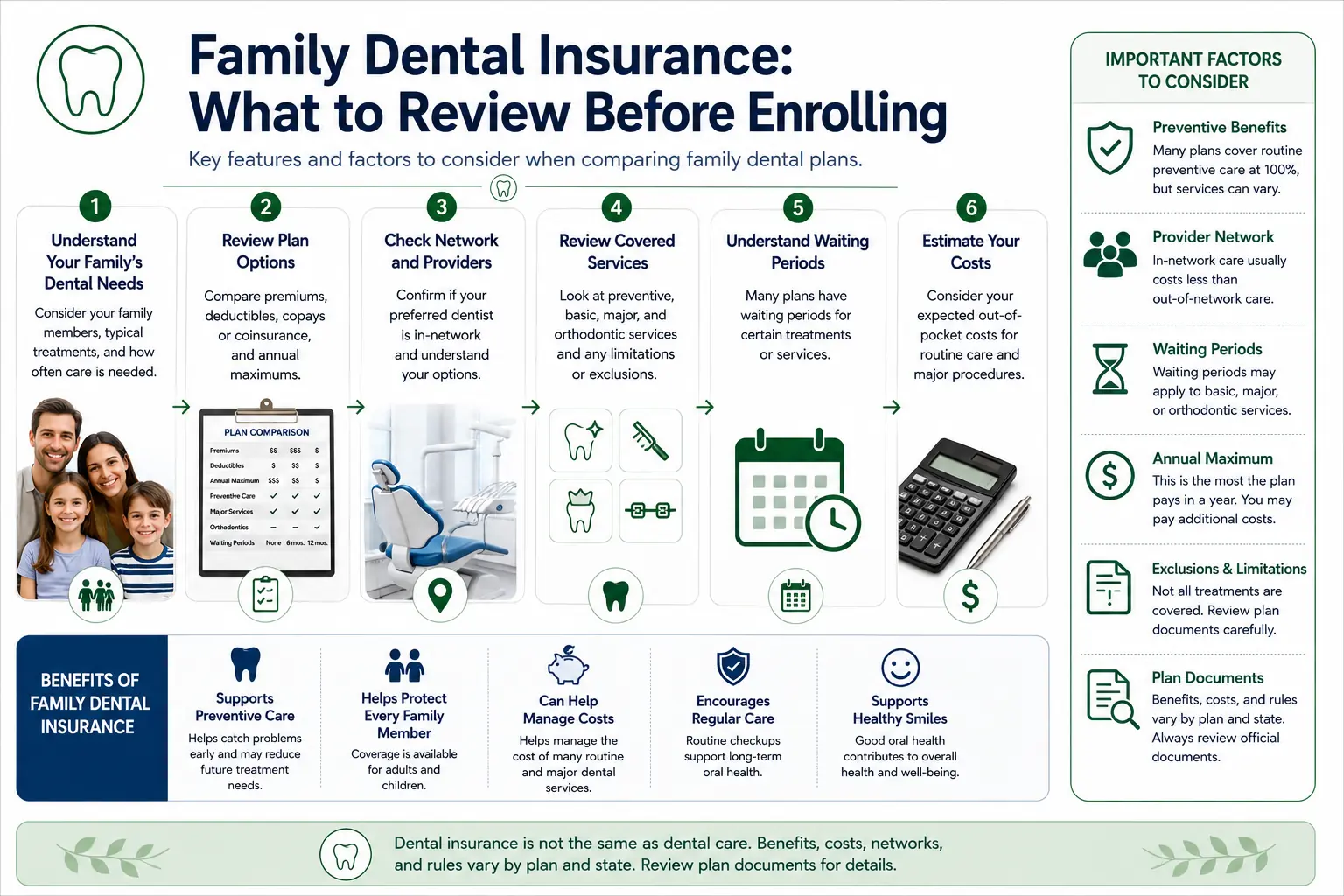
Important to Know:
- Family and individual pricing structures can differ by plan and coverage source.
- Pediatric dental benefits may be included in a health plan or offered separately.
- Orthodontic benefits, age limits, and provider networks vary by plan.
- Waiting periods, annual maximums, and other limitations may affect eligible services.
What If Family Dental Insurance Does Not Cover Enough?
A family dental plan may reduce some dental costs without covering every procedure or paying the entire bill.
When expected benefits are limited:
Request a Written Treatment Estimate
Ask the dental office for the procedure names, dental codes, estimated charges, and proposed treatment dates.
Compare the estimate with the plan’s deductible, coinsurance, annual maximum, waiting periods, exclusions, and network rules.
Ask Whether Treatment Can Be Phased
Some treatment may be completed in stages, but only the treating dental professional can determine whether postponing or phasing care is clinically appropriate.
Do not delay urgent or necessary treatment solely because of an insurance limitation.
Review Other Payment Arrangements
The dental office may offer a payment plan or third-party financing. These arrangements are not insurance.
Review the payment schedule, interest rate, fees, late-payment terms, and total amount due before agreeing.
A dental savings plan may also provide discounted fees through participating dentists, but it is not insurance. Confirm the membership cost, activation date, provider participation, written fee schedule, exclusions, and cancellation terms.
For a broader comparison, read our Dental Insurance vs Dental Savings Plans guide.
Questions to Ask Before Choosing Family Dental Insurance
| Question | Why It Matters |
|---|---|
| Who will be enrolled under the plan? | Eligibility, premiums, benefits, and dependent rules may differ according to age and household status. |
| Are benefits different for children and adults? | Pediatric preventive care, adult restorative treatment, orthodontics, and major services may follow different rules. |
| Are our dentists in the exact plan network? | Accepting insurance from a company does not always mean participating in every network offered by that company. |
| Are pediatric dentists and specialists accepting new patients? | Network participation does not guarantee appointment availability. |
| What is the effective date of coverage? | The enrollment date and the date benefits begin may not be the same. |
| Which services have waiting periods? | Preventive, basic, major, implant-related, and orthodontic services may have different eligibility dates. |
| Are deductibles individual, family-based, or both? | The deductible structure affects how much the household must pay before benefits apply. |
| Is the annual maximum individual or shared across the family? | Some plans apply a separate maximum to each member, while others may use additional family-level limits. |
| Does the plan include orthodontic benefits? | Orthodontic coverage may have age limits, waiting periods, lifetime maximums, and treatment-in-progress exclusions. |
| Are there frequency or replacement limits? | Exams, cleanings, X-rays, crowns, dentures, and other services may not be eligible as often as the family expects. |
| Are treatment-in-progress or missing-tooth provisions included? | These provisions may affect braces, bridges, dentures, implants, and treatment started before enrollment. |
| What will we pay for out-of-network care? | Allowed amounts, coinsurance, deductibles, and balance billing may increase household costs. |
| Is a pretreatment estimate recommended? | It may help clarify expected benefits for planned treatment, although it is not always a guarantee of final payment. |
| What documents describe the complete benefits and exclusions? | Online summaries may omit limitations found in the policy, certificate of coverage, or Summary Plan Description. |
| What happens if employment or family status changes? | Employer-sponsored coverage and dependent eligibility may end or change after certain life or employment events. |
Helpful Resources
Frequently Asked Questions
Is there one best dental insurance plan for every family?
No.
The more suitable option depends on the needs of each family member, the dentists and specialists the household wants to use, the expected treatment, the total cost, and the written limitations of the plan.
Is a family dental plan always cheaper than separate plans?
No.
Pricing can vary by insurer, employer contribution, coverage tier, household size, location, and plan design. Compare the total premium and expected out-of-pocket costs for each available arrangement.
Does family dental insurance automatically include orthodontic coverage?
No.
Some plans include orthodontic benefits for children, adults, or both, while others exclude orthodontics entirely. Age limits, waiting periods, lifetime maximums, network rules, and treatment-in-progress provisions may apply.
Are children and adults covered in the same way?
Not necessarily.
A family policy may apply different benefits, age limits, cost sharing, exclusions, and service rules to children and adults. Review the benefits separately for every person who will be enrolled.
Is pediatric dental coverage required in the Marketplace?
Pediatric dental coverage must be available for children age 18 or younger through a Marketplace health plan or a separate dental plan.
However, families are not required to purchase the pediatric dental coverage that is offered. Adult dental coverage is not an essential health benefit.
Can everyone in the family use a different dentist?
Possibly.
The family members may be able to use different dentists, but each provider and office location should be checked against the exact plan network. Some plan types may require members to select or receive care through assigned participating dentists.
Does every family member have a separate annual maximum?
It depends on the plan.
Many plans apply an annual maximum to each enrolled member. Other plans may also use family-level limits or different maximum structures. Confirm the exact terms in the official plan documents.
Does Medicaid provide dental benefits for families?
Medicaid requires dental benefits for enrolled children. Adult dental benefits are determined by each state and may be more limited.
CHIP must provide dental coverage for enrolled children, but benefit packages and participating providers can vary by state.
Can a family use a dental savings plan instead of insurance?
A dental savings plan may be considered as a separate way of accessing discounted fees, but it is not dental insurance.
Members generally pay a membership fee and then pay participating dentists directly at the applicable discounted rates. Provider participation, written fees, activation rules, exclusions, renewal terms, and membership costs should be verified before joining.
What happens when dental treatment has already started?
Treatment-in-progress rules may affect orthodontics, crowns, bridges, dentures, implants, and other ongoing care.
Ask the new insurer and dental office how the plan handles treatment that began before the effective date. Obtain the answer in writing whenever possible.
What should families compare first?
Begin with the people who need coverage, their current dentists, and the treatment they may reasonably expect.
Then compare provider networks, benefits, waiting periods, deductibles, cost sharing, annual maximums, orthodontic rules, exclusions, and total household costs.
Sources
- HealthCare.gov — Dental Coverage in the Marketplace
- American Dental Association — An Introduction to Dental Benefits
- American Dental Association — Typical Dental Plan Benefits and Limitations
- U.S. Department of Labor — Plan Information
- Medicaid.gov — Dental Care
- Medicaid.gov — CHIP Benefits
- National Association of Insurance Commissioners — Understanding Your Dental Insurance
About the Author
Maria Dumitru is the founder and content editor of Dental Coverage Hub. She researches and develops educational resources designed to help U.S. consumers understand dental insurance plans, coverage rules, costs, provider networks and comparison factors.
Learn more about our standards in the Editorial Policy and How We Review Dental Plans.
Dental Coverage Hub provides general educational information and does not provide medical, legal, financial or personalized insurance advice.

Compare Dental Plans With Confidence
Family dental coverage should support both routine care and future needs. Compare preventive care, pediatric benefits, orthodontic coverage, waiting periods, annual maximums, provider networks, and total out-of-pocket costs before enrolling.