
⭐ Practical Guidance
🇺🇸 Built for U.S. Consumers
💰 Cost Considerations

Does Dental Insurance Cover Invisalign? What You Need to Know in 2026
Invisalign has become a popular alternative to traditional braces. Learn how dental insurance may help cover treatment costs, what limitations may apply and which plan features are important to compare.
🟢 What You’ll Learn
Dental insurance may cover Invisalign, but only if your plan includes orthodontic benefits and allows clear aligner treatment.
This is where many people get confused. A dental plan may cover cleanings, fillings, or crowns, but that does not always mean it covers orthodontic care. And even when a plan includes orthodontic benefits, it may have rules about age, provider networks, waiting periods, lifetime benefit limits, pre-authorization, and whether clear aligners are included.
Invisalign is a specific brand of clear aligners. Clear aligners are removable trays that gradually move teeth. Traditional braces are fixed orthodontic appliances. From an insurance perspective, the most important question is not only whether you want Invisalign. It is whether your plan covers the type of orthodontic treatment your dentist or orthodontist recommends.
This guide explains how dental insurance may cover Invisalign, what plan rules to check, how Invisalign compares with braces from an insurance perspective, and what to do if your coverage is limited.
If you are still learning how dental insurance works, start with our Dental Plans guide to understand plan types, coverage categories, waiting periods, provider networks and common limits before comparing Invisalign or clear aligner coverage.
Quick Answer: Does Dental Insurance Cover Invisalign?
Dental insurance may cover Invisalign if the plan includes orthodontic benefits and treats clear aligners as an eligible orthodontic service.
Some plans cover orthodontic treatment for children or teens but not adults. Some may cover braces and clear aligners similarly, while others may limit coverage to certain treatment types or require pre-authorization before treatment begins.
Before starting Invisalign, ask whether your plan includes orthodontic coverage, whether adults are eligible, whether Invisalign or clear aligners are included, whether your provider is in network, whether a waiting period applies, and whether there is a lifetime orthodontic maximum.
Key Takeaways
- Dental insurance does not automatically cover Invisalign.
- Invisalign is usually reviewed under orthodontic benefits, not preventive, basic, or major dental care.
- Adult Invisalign coverage can be more limited than coverage for children or teens.
- Some plans may cover traditional braces and clear aligners similarly, while others may treat them differently.
- Orthodontic benefits may have a lifetime maximum instead of a regular annual maximum.
- A pre-authorization or written treatment estimate can help clarify coverage before treatment begins.
- If insurance does not cover enough, options may include payment plans, HSA or FSA funds, dental savings plans, orthodontic discount programs, dental schools, braces, or other clear aligners.
What Is Invisalign?
Invisalign is a brand of clear aligners used to help straighten teeth.
Clear aligners are removable trays that fit over the teeth and apply gentle pressure over time. The American Association of Orthodontists explains that clear aligners are plastic shells shaped to the patient’s mouth and used to gradually reposition teeth.
Clear aligners may be used for issues such as crowding, spacing, overbite, underbite, open bite, crossbite, or crooked teeth. However, aligners are not right for every case. The AAO notes that an orthodontist can determine whether braces, clear aligners, or a combination of approaches is best for a patient’s needs.
How Dental Insurance Usually Covers Invisalign
Dental insurance usually treats Invisalign as orthodontic care. That is important because orthodontic care is often handled separately from other dental services.
Routine cleanings may fall under preventive care. Fillings may fall under basic care. Crowns may fall under major restorative care. Invisalign usually falls under orthodontic benefits, if the plan includes them at all.
How Dental Insurance Covers Invisalign
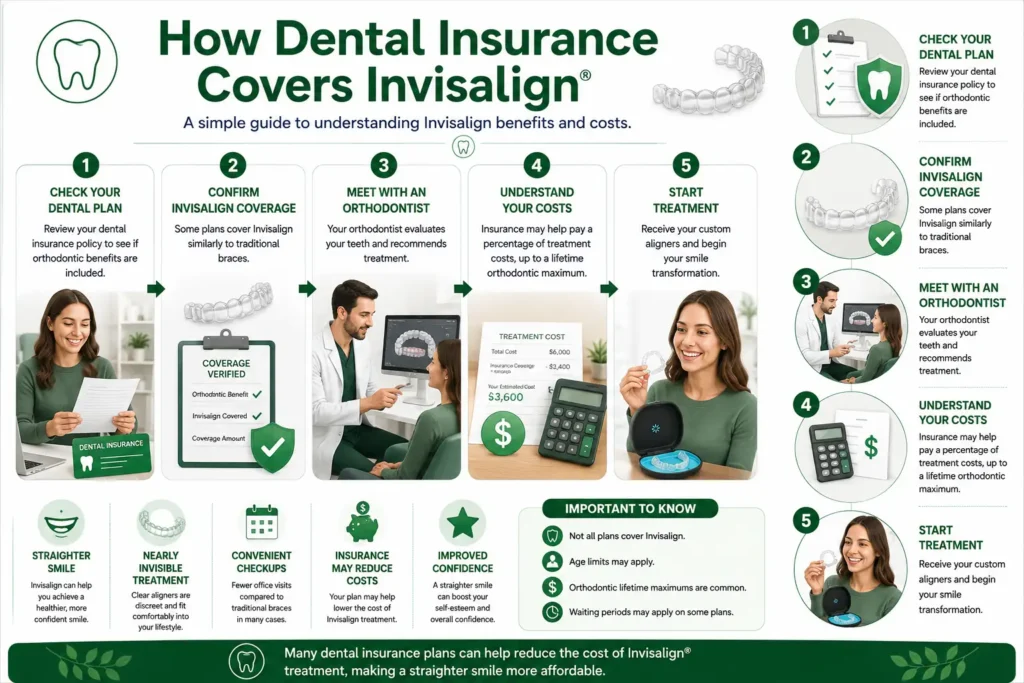
Important to Know:
- Not all plans cover Invisalign
- Age limits may apply
- Orthodontic lifetime maximums are common
- Waiting periods may apply on some plans
Why Invisalign Is Usually Orthodontic Care
Orthodontic treatment is used to correct tooth and bite alignment.
MouthHealthy, the American Dental Association’s consumer resource, explains that braces and orthodontic treatment are used to correct malocclusion, including crowded or crooked teeth and bite problems. It also notes that removable aligners are another option under the direct supervision of a dentist or orthodontist.
Because Invisalign is used to move teeth, insurance plans usually review it under orthodontic coverage.
What “Covered” Really Means
If a plan says orthodontics are covered, that does not automatically mean Invisalign is fully covered. It may mean the plan helps pay for eligible orthodontic treatment under certain rules.
You still need to check:
- Whether Invisalign is included
- Whether clear aligners are included
- Whether adults are eligible
- Whether your provider is in network
- Whether a waiting period applies
- Whether pre-authorization is required
- Whether a lifetime orthodontic maximum applies
- Whether the case is considered medically necessary or cosmetic
A better question is:
“Does my plan cover Invisalign or clear aligners for my age group, with this provider, under my current orthodontic benefits?”
Invisalign vs Clear Aligners vs Braces
These terms are related, but they are not exactly the same.
| Treatment type | What it means | Insurance question to ask |
|---|---|---|
| Invisalign | A specific brand of clear aligners | Does my plan cover Invisalign specifically? |
| Clear aligners | A broader category of removable orthodontic trays | Does my plan cover clear aligner therapy? |
| Traditional braces | Fixed brackets and wires used to move teeth | Does my plan cover braces, and are braces treated differently from aligners? |
Invisalign
Invisalign is one brand within the larger clear aligner category.
Some plans may mention clear aligners generally. Others may refer to orthodontic treatment without naming specific products. That is why you should ask about the exact treatment being recommended.
Clear Aligners
Clear aligners are removable trays that gradually shift teeth.
From an insurance perspective, a plan may treat clear aligners as orthodontic treatment. But coverage can still depend on plan language, provider network, age limits, and medical necessity.
Traditional Braces
Traditional braces use brackets and wires to move teeth.
Some plans may clearly cover braces but be less clear about aligners. Others may treat both similarly if orthodontic benefits are included. The AAO states that dental plans with orthodontic coverage usually cover traditional braces and clear aligners equally, but each plan is different and accepted coverage varies.
What Plan Rules Can Affect Invisalign Coverage?
Several plan rules can affect whether Invisalign is covered and how much the plan may help.
Orthodontic Benefits
The first question is whether your plan includes orthodontic benefits.
Some dental plans cover preventive and restorative care but do not include orthodontics. If the plan does not include orthodontic benefits, Invisalign is unlikely to be covered.
Adult Coverage Limits
Adult Invisalign coverage is not guaranteed.
Some plans include orthodontic benefits only for children or teens. Others may include adults. Some may include adults only under certain conditions.
HealthCare.gov explains that dental coverage is treated differently for adults and children in the Marketplace: dental coverage must be available for children, while adult dental coverage is not an essential health benefit.
This is why adults should never assume orthodontic benefits apply to them automatically.
Lifetime Orthodontic Maximum
Orthodontic benefits may have a lifetime maximum instead of a regular annual maximum. That means the plan may limit how much it will pay toward orthodontic care over the covered person’s lifetime.
The ADA’s introduction to dental benefits shows that orthodontic benefits may be handled separately from other annual dental benefits and may be subject to a separate lifetime maximum.
Waiting Periods
A waiting period is the time you must wait after your plan starts before certain benefits are available.
Some dental plans may apply waiting periods to orthodontic treatment. HealthCare.gov explains that stand-alone dental plans can have waiting periods, and services affected by the waiting period are not covered until that period ends.
If you need Invisalign soon, check waiting periods before enrolling or starting treatment.
In-Network Provider Rules
Your plan may pay more predictably when you use an in-network dentist or orthodontist. If your provider is out of network, your out-of-pocket cost may be higher, or the plan may not apply the same benefits.
Before treatment begins, confirm network status with both the provider’s office and the insurance company.
Pre-Authorization or Pre-Treatment Estimate
Some plans require pre-authorization before orthodontic treatment begins. A pre-treatment estimate can help clarify whether Invisalign is eligible, what benefit may apply, whether age limits affect coverage, and what you may owe.
It is not always a final guarantee of payment, but it can reduce surprises.
Medical Necessity vs Cosmetic Treatment
Orthodontic treatment may be more likely to receive coverage when it is connected to function, bite correction, or oral health needs.
If treatment is considered mainly cosmetic, coverage may be limited or denied. IRS guidance also distinguishes between dental treatment for disease or function and cosmetic procedures, noting that dental treatment can include braces, while purely cosmetic expenses such as teeth whitening are not included as medical expenses.
When Invisalign May Not Be Covered
Invisalign may not be covered in several common situations.
The Plan Has No Orthodontic Benefit
If your plan does not include orthodontic benefits, Invisalign is usually not covered. This can happen even if the plan covers cleanings, fillings, crowns, or other dental services.
Adult Orthodontics Are Excluded
A plan may cover orthodontics for children or teens but not for adults. This is one of the most important details for adults considering Invisalign.
Clear Aligners Are Excluded
Some plans may cover orthodontic treatment but limit which appliances are eligible. Ask whether Invisalign, clear aligners, removable aligners, or alternative orthodontic appliances are included.
Treatment Is Considered Cosmetic
If the treatment is mainly for appearance and not connected to bite correction or oral function, the plan may not cover it. Ask your provider how the treatment will be documented and whether the plan requires proof of medical necessity.
The Provider Is Out of Network
If the orthodontist or dentist is not in network, the plan may pay less or may not apply the same orthodontic benefit. Network status matters before you sign a treatment agreement.
How Age and Plan Type Can Affect Invisalign Coverage
Invisalign coverage can depend on age and how the dental plan is obtained.
Adults should check whether the plan includes adult orthodontic benefits. Parents should confirm whether orthodontic benefits apply to children, teens or dependents. Employees should review employer plan details during open enrollment, while individual plan shoppers should read the official plan documents before assuming orthodontics are included.
The most important questions are whether clear aligners are eligible, whether the provider is in network, whether a waiting period applies, and whether there is a lifetime orthodontic maximum.
Invisalign vs Braces From an Insurance Perspective
Invisalign and traditional braces may both be orthodontic treatments, but dental plans do not always treat them the same way. Some plans may cover both if orthodontic benefits are included. Others may cover braces more clearly than clear aligners, or may limit coverage by age, provider type, medical necessity or appliance type.
Ask whether the plan covers Invisalign specifically, whether clear aligners are included, whether adult orthodontics are eligible, whether your provider must be in network, whether pre-authorization is required, and whether braces would be covered differently.
For a deeper look at braces coverage, read our Dental Insurance for Braces guide.
How to Check Your Invisalign Coverage Before Treatment
Before starting Invisalign, gather the details in writing.
Ask for a Written Treatment Plan
Ask your dentist or orthodontist for a written treatment plan that identifies the recommended treatment, provider, expected services, and any procedure information needed for insurance review.
Call Your Insurance Company
Call the insurance company and ask specifically about orthodontic benefits. Use the word “Invisalign” and also ask about “clear aligners,” because some plan documents may use different wording.
Confirm Adult or Child Eligibility
Ask whether orthodontic benefits apply to your age group. For parents, ask whether the benefit applies to children, teens, or dependents and whether any plan-specific age rules apply.
Ask About the Lifetime Maximum
Ask whether orthodontics have a separate lifetime maximum. If you used orthodontic benefits in the past, ask whether any benefit remains.
Confirm Provider Network Status
Ask whether your orthodontist or dentist is in network for your exact plan. Also ask whether the plan requires treatment from a specialist or allows treatment from a general dentist.
Request Pre-Authorization
If your plan offers or requires pre-authorization, request it before starting treatment. This can help you avoid beginning treatment based on assumptions.
What If Insurance Does Not Cover Enough?
Insurance is only one part of Invisalign cost planning. If coverage is limited or unavailable, compare other options before deciding.
Ask About Orthodontic Payment Plans
Many orthodontic offices offer payment arrangements. Ask for the terms in writing and review payment timing, fees, and what happens if treatment changes.
Use HSA or FSA Funds When Available
HSA or FSA funds may help with eligible orthodontic expenses when available. IRS Publication 502 includes braces as a type of dental treatment for medical expense purposes, but account rules can vary, so confirm eligibility with your account administrator before relying on these funds.
Consider Dental Savings or Orthodontic Discount Plans
A dental savings plan or orthodontic discount program is not insurance. It may provide access to reduced fees with participating providers, but it does not pay claims like insurance. Check whether the provider participates, what services are discounted, and whether Invisalign or clear aligners are included.
Ask About Dental Schools
Dental schools or orthodontic residency programs may offer supervised treatment at lower cost. Availability, wait times, and treatment options vary by location.
Compare Invisalign With Braces or Other Clear Aligners
If Invisalign is not covered or is not the best fit for your plan, ask your orthodontist whether braces or another clear aligner option would be clinically appropriate. Do not choose treatment based only on coverage. The right treatment should match your bite, tooth movement needs, oral health, and ability to follow the treatment plan.
Questions to Ask Before Starting Invisalign
| Question | Why it matters |
| Does my plan include orthodontic benefits? | Invisalign is usually reviewed under orthodontic coverage |
| Does the plan cover Invisalign specifically? | Some plans may not list every clear aligner option |
| Are clear aligners covered? | Plan wording may use broader terms than Invisalign |
| Are adults eligible? | Adult orthodontic coverage may be limited |
| Is my provider in network? | Network status can affect out-of-pocket cost |
| Is pre-authorization required? | Some plans review treatment before benefits apply |
| Is there a lifetime orthodontic maximum? | Orthodontic benefits may have a separate limit |
| Is there a waiting period? | Coverage may not begin right away |
| Are braces covered differently? | A different treatment may have different coverage |
| Can HSA or FSA funds be used? | Tax-advantaged funds may help with eligible costs |
Our Recommendation
Before starting Invisalign, confirm coverage in writing.
Start with the clinical question: is Invisalign, braces or another orthodontic treatment appropriate for your case? Then ask the insurance question: does your plan include orthodontic benefits, and do those benefits apply to Invisalign or clear aligners?
Adults should pay special attention to age rules, provider networks, pre-authorization requirements and lifetime orthodontic maximums. Parents should check child and teen orthodontic benefits before treatment begins.
The best approach is to compare the full picture: orthodontic benefits, lifetime maximums, waiting periods, provider network, pre-authorization rules, adult coverage and alternatives.
When you are ready to review options, compare dental plans based on orthodontic benefits, clear aligner eligibility, provider access, waiting periods and lifetime maximums.
Helpful Resources
🔥Our Editorial Standards
Dental Coverage Hub is committed to providing clear, educational and regularly reviewed information about dental plans and dental insurance.
Sources
- American Association of Orthodontists — Clear Aligners
- MouthHealthy / American Dental Association — Braces
- American Dental Association — Introduction to Dental Benefits
- HealthCare.gov — Dental Coverage in the Marketplace
- IRS Publication 502 — Medical and Dental Expenses
Frequently Asked Questions
Does dental insurance cover Invisalign?
Dental insurance may cover Invisalign if the plan includes orthodontic benefits and clear aligners are eligible under the plan.
Coverage depends on plan rules, age limits, provider network, waiting periods, lifetime maximums, and pre-authorization requirements.
Is Invisalign covered the same as braces?
Sometimes.
Some plans treat Invisalign and braces similarly under orthodontic benefits. Other plans may cover braces but limit or exclude clear aligners. Always ask about Invisalign specifically.
Does dental insurance cover Invisalign for adults?
Some plans cover adult orthodontics, but many do not.
Adults should confirm whether orthodontic benefits apply to them before starting treatment.
Does dental insurance cover Invisalign for teens?
Some family or employer dental plans may include orthodontic benefits for teens.
Parents should check age limits, lifetime maximums, provider network rules, and whether clear aligners are eligible.
Is Invisalign considered cosmetic by insurance?
It can be, depending on the plan and the reason for treatment.
If treatment is mainly for appearance, coverage may be limited. If treatment addresses bite, alignment, or function, the plan may review it differently.
What is an orthodontic lifetime maximum?
An orthodontic lifetime maximum is the most the plan will pay toward orthodontic treatment for a covered person over that person’s lifetime.
It is different from a regular annual maximum.
Do I need pre-authorization for Invisalign?
Some plans require pre-authorization before orthodontic treatment begins.
Even when it is not required, a pre-treatment estimate can help clarify likely coverage.
Can I use HSA or FSA funds for Invisalign?
You may be able to use HSA or FSA funds for eligible orthodontic expenses, depending on your account rules.
Confirm with your account administrator before treatment begins.
What if my insurance does not cover Invisalign?
Ask for a written treatment estimate and compare payment plans, HSA or FSA funds, dental savings plans, orthodontic discount programs, dental schools, braces, or other clear aligner options.
Last reviewed: July, 2026
Author Note : Reviewed by Dental Coverage Hub Editorial Team.
Content is reviewed regularly to help ensure information remains accurate, practical and useful for consumers exploring dental coverage options in the United States.
✅ This article is intended for educational purposes only and should not be considered insurance, financial or legal advice.

Compare Dental Plans With Confidence
Invisalign coverage can vary by plan. Compare orthodontic benefits, clear aligner eligibility, provider networks, waiting periods and lifetime maximums before starting treatment.