
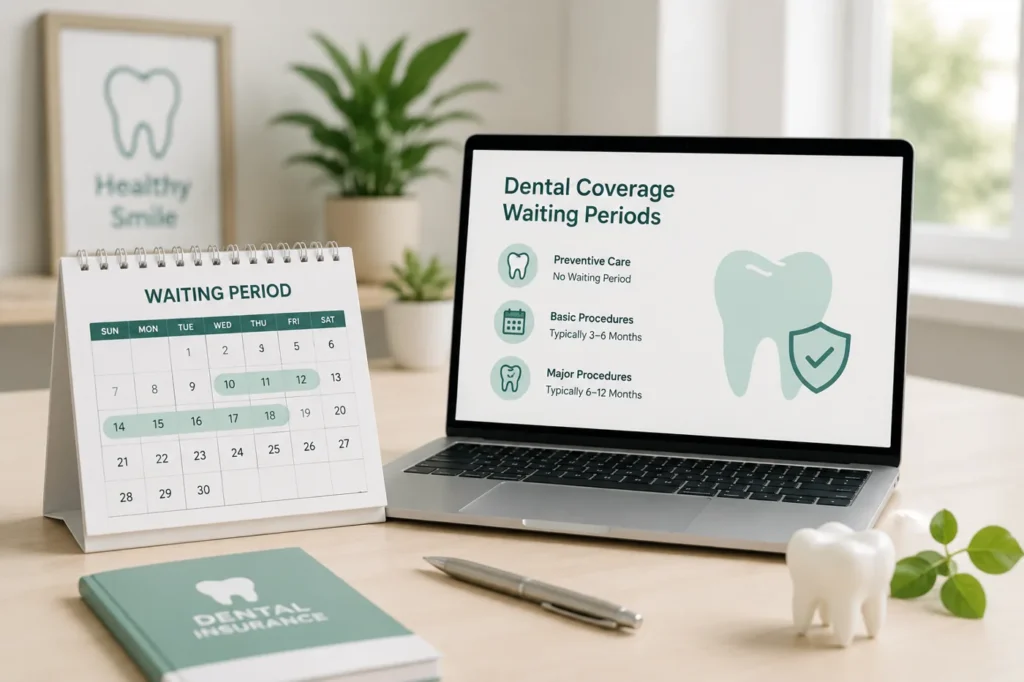
How Waiting Periods Work in Dental Coverage
🇺🇸 Built for U.S. Consumers
⚡ Waiting Period Basics
💰 Avoid Unexpected Costs
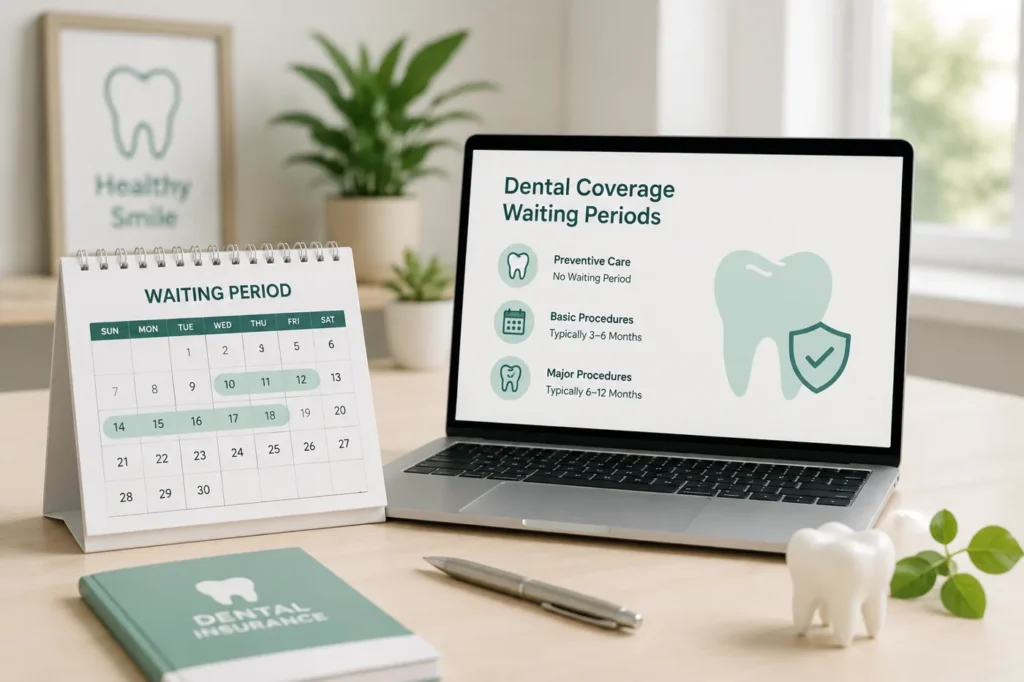
🟢What You’ll Learn
Dental coverage can help make dental care more affordable, but coverage does not always begin for every service on the first day your plan starts.
Some dental plans cover preventive care right away, while fillings, extractions, crowns, root canals, dentures, implants, or braces may have a waiting period. That means you may need to stay enrolled for a certain number of months before the plan helps pay for those services.
This can be frustrating if you already need dental treatment soon. You may be paying premiums, but your plan may not yet pay for the procedure you need.
This guide explains how dental coverage waiting periods work, which services are commonly affected, what costs may still apply after the waiting period ends, and what you can do if you need care before benefits become available.
If you are still learning how dental plans work, start with our Dental Plans guide to understand plan types, costs, coverage categories, provider networks and common limits before comparing waiting periods.
Quick Answer: What Is a Dental Insurance Waiting Period?
Dental insurance waiting periods can feel confusing, especially if you need dental care soon.
A dental insurance waiting period is the amount of time you may need to wait after your plan starts before certain dental benefits become available.
Preventive care, such as exams, cleanings and X-rays, may be available right away. Basic care, major services, orthodontics or implant-related services may have separate waiting periods, depending on the plan.
If you receive a service before the waiting period ends, the plan may not pay for that service, even if the plan is already active.
Key Takeaways
A dental plan can be active before every benefit is available.
Preventive care is the most likely category to be available immediately.
Basic, major, orthodontic, and implant-related services may have different waiting periods.
A service can be listed as covered but still be subject to a waiting period, deductible, coinsurance, annual maximum, frequency limit, or network rule.
Employer-sponsored dental plans may have different waiting-period rules than individual or family plans.
Waiting periods may sometimes be waived if you had recent comparable dental coverage.
If you need care before a waiting period ends, you may want to compare no-wait dental plans, ask about prior coverage credit, use preventive benefits right away, discuss phased treatment, consider a dental savings plan, or ask your dentist about payment options.
What Is a Dental Coverage Waiting Period?
A dental coverage waiting period is a delay between the date your plan becomes active and the date certain dental benefits become available.
For example, your plan may begin on January 1. Your preventive benefits may be available immediately, but your plan may require a six-month wait for fillings and a twelve-month wait for crowns.
In that situation, your coverage is active, but not every service is eligible for payment right away.
Delta Dental explains that waiting periods differ by plan and that preventive or diagnostic services often have no waiting period, while restorative or major services may have longer waits.
Waiting Period vs Effective Date
The effective date is the date your dental plan officially starts.
The waiting period is the time you may need to wait after that date before certain services are eligible for benefits.
These are not the same thing. Your plan can be active while some benefits are still not available.
Covered Does Not Always Mean Payable Today
A dental service can be listed as covered in the plan documents, but that does not always mean the plan will pay for it immediately.
For example, a crown may be a covered major service, but if major services have a 12-month waiting period, the plan may not help pay until that waiting period is over.
Even after the waiting period ends, deductibles, coinsurance, annual maximums, replacement limits and network rules may still apply.
Why Do Dental Plans Have Waiting Periods?
Dental plans may use waiting periods to manage risk and keep plan costs more stable.
Without waiting periods, someone could enroll after learning they need expensive care, use the plan for major treatment, and cancel soon afterward.
That does not make waiting periods easy for patients. If your dentist says treatment is needed, ask how urgent it is before delaying care for insurance reasons.
Which Dental Services Usually Have Waiting Periods?
| Service category | Common examples | Typical waiting-period pattern |
|---|---|---|
| Preventive care | Exams, cleanings, X-rays | Often no waiting period |
| Basic care | Fillings, simple extractions | May have no wait or a shorter wait |
| Major care | Crowns, bridges, dentures, root canals | Often longer waiting period |
| Orthodontics | Braces, clear aligners | May have separate rules |
| Implants | Implant placement, implant crown | Plan-dependent; may be limited or excluded |
These are general patterns only. Waiting periods can vary by plan, state, provider network and service category. Always review the official plan documents before enrolling.
For treatment-specific questions, review our Dental Insurance Coverage for Common Procedures guide.
How Dental Insurance Waiting Periods Work
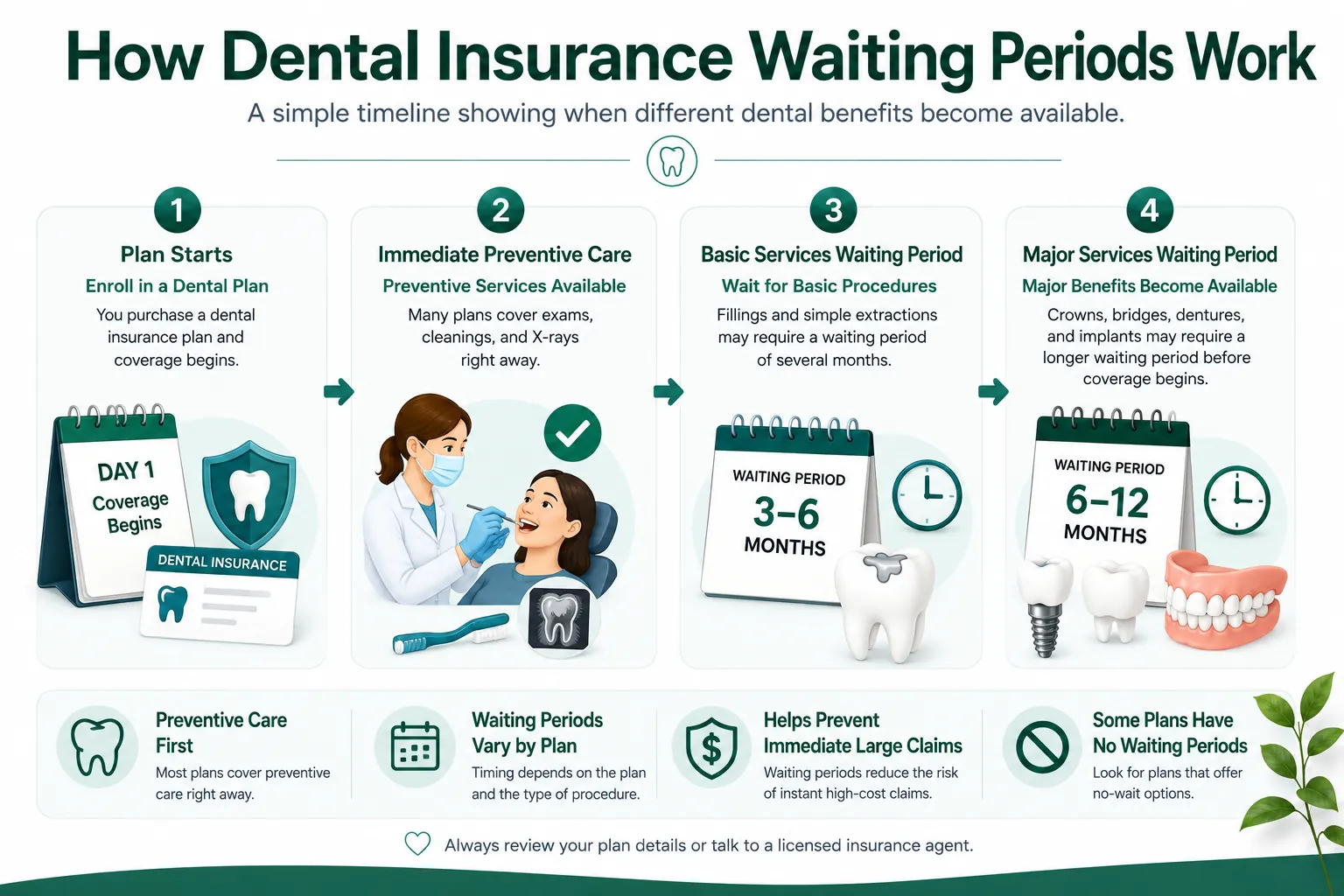
This visual overview shows how preventive, basic and major dental benefits may become available at different times, depending on the plan.
Waiting Periods Are Only One Part of the Cost
Even after a waiting period ends, you may still have out-of-pocket costs.
Check:
- Deductible
- Copay or coinsurance
- Annual maximum
- Network rules
- Frequency limits
- Replacement limits
- Exclusions
A plan may start paying after the waiting period, but that does not always mean it pays the full cost.
What Happens If You Get Treatment During the Waiting Period?
You can still visit the dentist during a waiting period.
However, if the service is still under a waiting period, the plan may not pay for it. You may need to pay the full cost yourself or ask the dental office about other payment options.
Before scheduling treatment, ask your dentist for the procedure code and ask the plan whether that service is eligible for benefits yet.
Simple Example: A Filling Before and After a Waiting Period
Assume a filling has an in-network allowed amount of $250.
If the plan has a six-month waiting period for basic services and you get the filling before the waiting period ends, the plan may pay $0.
If the waiting period has ended, the plan may apply the deductible and coinsurance rules.
This is only an educational example. Actual dental fees, allowed amounts, deductibles, coinsurance and plan rules vary.
Can Dental Waiting Periods Be Waived?
Sometimes, yes.
A dental plan may waive or reduce waiting periods if you had recent comparable dental coverage before enrolling in the new plan.
Delta Dental says that, in certain cases, a waiting period may be waived if a comparable dental insurance plan ended in the 30 to 60 days before the new plan’s effective date, and the prior plan had very similar coverage.
Prior Comparable Coverage
Prior comparable coverage means you had a dental plan before the new one and the coverage was similar enough to qualify under the new plan’s rules.
You may need to provide proof of coverage, such as a certificate of prior coverage, employer benefits documentation, or information from your previous insurer.
Employer-Sponsored Plans
Employer dental plans may have different waiting-period rules than individual dental plans.
Some employer plans reduce or waive waiting periods because the employer group spreads risk across many employees. Other employer plans may still have waiting periods, especially for late enrollment or certain categories of care.
If you are choosing dental coverage through work, ask HR or the benefits administrator for the plan summary and waiting-period schedule.
Switching Plans Without a Coverage Gap
If you are switching dental plans, try to avoid a gap in coverage.
A gap may make it harder to qualify for a waiting-period waiver. The specific rules vary by insurer and plan.
What If You Need Dental Care Before the Waiting Period Ends?
If you need treatment before the waiting period ends, do not assume your only options are paying full price or waiting.
You may be able to:
- Use preventive benefits right away, if available
- Ask your dentist for a written treatment plan
- Ask the insurer when the waiting period ends
- Compare no-waiting-period dental plans
- Consider a dental savings plan
- Ask the dental office about payment options
- Discuss whether treatment can be phased safely
Do not delay urgent care without your dentist’s guidance.
Waiting Periods May Vary by Plan Type
Waiting-period rules may differ between individual dental plans, employer-sponsored plans and other coverage options.
If you are choosing coverage through work, ask HR for the plan summary and waiting-period schedule.
If you are buying your own plan, review waiting periods before comparing only monthly premiums.
How to Compare Dental Plans With Waiting Periods
Step 1: Check Each Service Category
Do not ask only, “Does this plan have a waiting period?”
Ask about each category:
- Preventive care
- Basic services
- Major services
- Orthodontics
- Implants
- Dentures
- Specialist care
Step 2: Ask for the Effective Date
Ask when the plan starts.
If you enroll today, coverage may not begin today. Some plans begin on the first day of the following month or another scheduled effective date.
Step 3: Ask When Each Waiting Period Ends
Ask for exact dates, not just “six months” or “twelve months.”
If your policy starts on April 1, ask when basic services and major services become eligible.
Step 4: Check Deductibles and Coinsurance
Even after the waiting period ends, you may still pay part of the cost.
Ask what deductible applies and what percentage the plan pays for each service category.
Step 5: Check the Annual Maximum
A plan may cover major services after twelve months but still have a low annual maximum.
If you need multiple procedures, the maximum may limit the plan’s value.
Step 6: Verify the Dentist Network
A plan is useful only if you can use it with a dentist you trust or a qualified participating provider.
Call both the insurer and the dental office to confirm network participation.
Step 7: Read Exclusions
Look for missing tooth clauses, treatment-in-progress exclusions, implant exclusions, orthodontic rules, cosmetic exclusions, and replacement limits.
Step 8: Ask About Waiting-Period Waivers
If you had recent dental coverage, ask whether the new plan will waive or reduce waiting periods.
Get the answer in writing when possible.
💚Our Recommendation
Do not choose dental coverage based only on the monthly premium or the phrase “no waiting period.”
Start with your real dental needs.
If you are buying your own plan, compare waiting periods carefully before focusing only on monthly premiums. If you are choosing coverage through an employer, ask HR or the benefits administrator whether group-plan rules reduce or waive waiting periods.
The best plan is not always the cheapest plan. It is the plan that gives you the right balance of timing, coverage, provider access and out-of-pocket cost.
When you are ready to review options, compare dental plans by looking at waiting periods together with deductibles, coinsurance, annual maximums, covered services, provider networks and the care you expect to need.
Questions to Ask Before Enrolling
| Question | Why it matters |
| What is the policy effective date? | Your plan must be active before benefits can apply |
| Is there a waiting period for preventive care? | Preventive care is often available immediately |
| Is there a waiting period for fillings or extractions? | These may be basic services with separate rules |
| Is there a waiting period for crowns, root canals, or dentures? | Major services often have longer waits |
| Are implants covered or excluded? | Implant rules vary widely |
| Are orthodontic benefits included? | Braces and aligners may have separate rules |
| Can prior coverage waive the waiting period? | Recent comparable coverage may help |
| What deductible applies? | You may pay this before benefits begin |
| What coinsurance or copay applies? | Coverage rarely means the plan pays 100% |
| What is the annual maximum? | The plan may stop paying after this amount |
| Is my dentist in network? | Network status can change your cost |
| Are there missing tooth or treatment-in-progress exclusions? | These can affect dentures, bridges, implants, and ongoing care |
📚Helpful Resources
Sources
- HealthCare.gov — Dental Coverage in the Marketplace.
- American Dental Association — An Introduction to Dental Benefits.
- Delta Dental — Dental Insurance Waiting Period Explained.
🔥Our Editorial Standards
Dental Coverage Hub is committed to providing clear, educational and regularly reviewed information about dental plans and dental insurance.
Frequently Asked Questions
What is a dental coverage waiting period?
A dental coverage waiting period is the amount of time you must wait after your plan starts before certain benefits become available. Preventive care is often available right away, while basic, major, orthodontic, or implant-related care may have separate waiting periods.
Can I go to the dentist during a waiting period?
Yes. You can go to the dentist during a waiting period.
However, your plan may not pay for services that are still under the waiting period. You may need to pay the full cost or ask about other payment options.
Are cleanings usually covered right away?
Many dental plans cover preventive services such as exams, cleanings, and X-rays without a waiting period.
You should still confirm the plan’s effective date, network rules, and frequency limits.
How long is a dental insurance waiting period?
Waiting periods vary by plan.
Some plans have no waiting period for preventive care, a shorter wait for basic care, and a longer wait for major care. Some plans may have no waiting period for certain services, while others may require several months.
Do employer dental plans have waiting periods?
Some employer dental plans have waiting periods, and others reduce or waive them.
Ask your HR department or benefits administrator for the plan’s waiting-period schedule, especially if you are a new employee or late enrollee.
Can dental waiting periods be waived?
Sometimes.
A plan may waive or reduce waiting periods if you had recent comparable dental coverage and avoided a coverage gap. Rules vary by insurer and plan.
Can major dental work have a waiting period?
Yes. Major services such as crowns, dentures, bridges, root canals or implants may have waiting periods, depending on the plan. Always check the exact procedure code and plan category before scheduling care.
Is no-waiting-period dental insurance always better?
Not always.
A no-waiting-period plan may still have higher premiums, lower first-year benefits, deductibles, coinsurance, annual maximums, or network limits.
Compare the total cost and exact benefits, not just the waiting-period headline.
Are dental savings plans a good alternative during a waiting period?
A dental savings plan may help if you need immediate discounts and your dentist participates.
However, it is not insurance. It does not pay part of your bill. You pay the discounted rate directly to the dentist.
Last reviewed: July 11, 2026
About the Author: M.D.-Content creator and researcher focused on helping consumers better understand dental plans, coverage options and dental insurance concepts.
Dental Coverage Hub regularly reviews content to improve accuracy, clarity and usefulness.
✅ This article is intended for educational purposes only and should not be considered insurance, financial or legal advice.

Ready to Compare Dental Plans?
Waiting periods can affect when your plan helps pay for care. Before enrolling, compare coverage timing, costs, plan limits and dentist access side by side.