🦷 Clear Aligner Coverage
🇺🇸 Built for U.S. Consumers
✓ Orthodontic Benefit Guidance

Does Dental Insurance Cover Invisalign? What to Verify Before Treatment
Learn how dental plans may evaluate Invisalign and other clear aligners, including age eligibility, orthodontic networks, waiting periods, lifetime maximums, treatment-in-progress rules, and expected costs.
Written and researched by Maria Dumitru.
Founder and Content Editor at Dental Coverage Hub
Last reviewed: August 2026
What You’ll Learn
Dental insurance may provide orthodontic benefits for Invisalign or other clear aligners, but coverage depends on the exact treatment and contract terms.
Invisalign is a specific brand within the broader category of clear aligner treatment. A dental plan may refer to clear aligners, removable orthodontic appliances, comprehensive orthodontic treatment, or another benefit category without naming a particular brand.
A plan that includes orthodontic benefits does not automatically cover every aligner system or every covered person. Eligibility can depend on age, dependent status, provider network, policy effective date, waiting periods, lifetime orthodontic maximums, previous benefit usage, treatment-in-progress provisions, and the required advance-review process.
This guide explains how to identify the treatment being recommended, verify clear aligner eligibility, review orthodontic limits, compare provider access, and estimate the remaining patient cost before treatment begins.
For a broader explanation of plan types, provider networks, costs, waiting periods, and benefit limitations, begin with the Dental Plans Guide.
Quick Answer
Dental insurance may cover Invisalign when the policy includes orthodontic benefits and the recommended clear aligner treatment is eligible under the plan.
However, the existence of orthodontic coverage does not guarantee that:
- Invisalign is included.
- Other clear aligner systems are included.
- Adult orthodontics are covered.
- Every dependent is eligible.
- The complete treatment fee will be paid.
- The treating dentist or orthodontist participates in the required network.
- Treatment already started will qualify.
- Retainers, refinements, replacement trays, or follow-up services are included.
Before treatment begins, confirm:
- The exact treatment and procedure codes.
- The eligible person and age group.
- The provider and office network.
- The policy effective date.
- The orthodontic waiting period.
- The lifetime orthodontic maximum.
- Benefits previously used.
- Treatment-in-progress rules.
- Preauthorization or predetermination requirements.
- The estimated plan payment and patient responsibility.
Review the official policy, orthodontic benefit schedule, exclusions, and provider directory rather than relying only on a general statement that orthodontics are covered.
Key Takeaways
- Invisalign is a specific clear aligner brand, while clear aligners are a broader category of orthodontic treatment.
- Orthodontic benefits do not automatically include Invisalign or every other aligner system.
- Child, teen, dependent, and adult orthodontic eligibility may differ under the same plan.
- Clear aligners and traditional braces may follow the same lifetime maximum while still having different eligibility or member-cost rules.
- Previous orthodontic benefits may reduce the amount still available.
- The effective date, waiting period, provider network, treatment-in-progress rules, and continued enrollment can affect payment.
- Preauthorization and predetermination are distinct processes and do not necessarily guarantee final payment.
- The treatment decision should reflect the clinical diagnosis, while insurance eligibility should be verified separately through the plan documents.
In This Guide
Invisalign and Clear Aligner Treatment
Invisalign
Invisalign is a brand of clear aligner treatment.
The treatment generally uses a planned sequence of removable aligners designed to move teeth gradually.
The brand name alone does not determine insurance coverage. A plan may refer more generally to clear aligners, removable orthodontic appliances, or comprehensive orthodontic treatment.
Clear Aligners
Clear aligners are custom-made, removable trays used in a planned sequence to move teeth.
They are not appropriate for every orthodontic condition. The dental professional or orthodontist should evaluate:
- Tooth and jaw alignment.
- Bite relationships.
- Oral health.
- Treatment complexity.
- Expected tooth movement.
- The patient’s ability to follow wear and care instructions.
- Whether braces, aligners, or another approach is clinically appropriate.
AAO explains that some, but not all, orthodontic conditions can be treated successfully with clear aligners and that treatment suitability requires professional evaluation.
Traditional Braces
Traditional braces use fixed brackets, wires, and related components to move teeth.
A plan may evaluate braces and clear aligners under the same general orthodontic benefit while still applying different:
- Covered-service definitions.
- Provider rules.
- Member charges.
- Appliance restrictions.
- Documentation requirements.
- Treatment-in-progress provisions.
Do not assume that coverage for braces automatically establishes identical coverage for Invisalign.
Clinical Recommendation and Insurance Eligibility
The treating professional determines which treatment options are clinically appropriate.
The dental plan determines whether the recommended treatment qualifies for benefits under the contract.
A larger insurance benefit for one treatment does not establish that it is clinically more appropriate for the patient.
How Dental Plans May Evaluate Clear Aligner Treatment
Dental plans commonly evaluate clear aligner treatment through orthodontic benefits rather than ordinary diagnostic, preventive, restorative, or major-care benefits.
A plan may:
- Include clear aligners as eligible orthodontic treatment.
- Include orthodontics but exclude selected aligner systems.
- Provide orthodontic benefits only for children or eligible dependents.
- Include adult orthodontics under different rules.
- Require treatment through a participating orthodontist or dental provider.
- Apply a waiting period.
- Use a lifetime orthodontic maximum.
- Divide payments across the treatment period.
- Require continued enrollment for future payments.
- Limit or exclude treatment already started.
- Require preauthorization or offer predetermination.
The statement “orthodontics covered” does not reveal whether Invisalign is eligible, how much the plan may pay, or which provider and timing requirements apply.
Ask about the exact clear aligner treatment recommended for the covered person.
How Dental Insurance Covers Invisalign
A visual summary of clear aligner eligibility, age rules, provider networks, waiting periods, lifetime orthodontic maximums, treatment reviews, and expected patient costs.
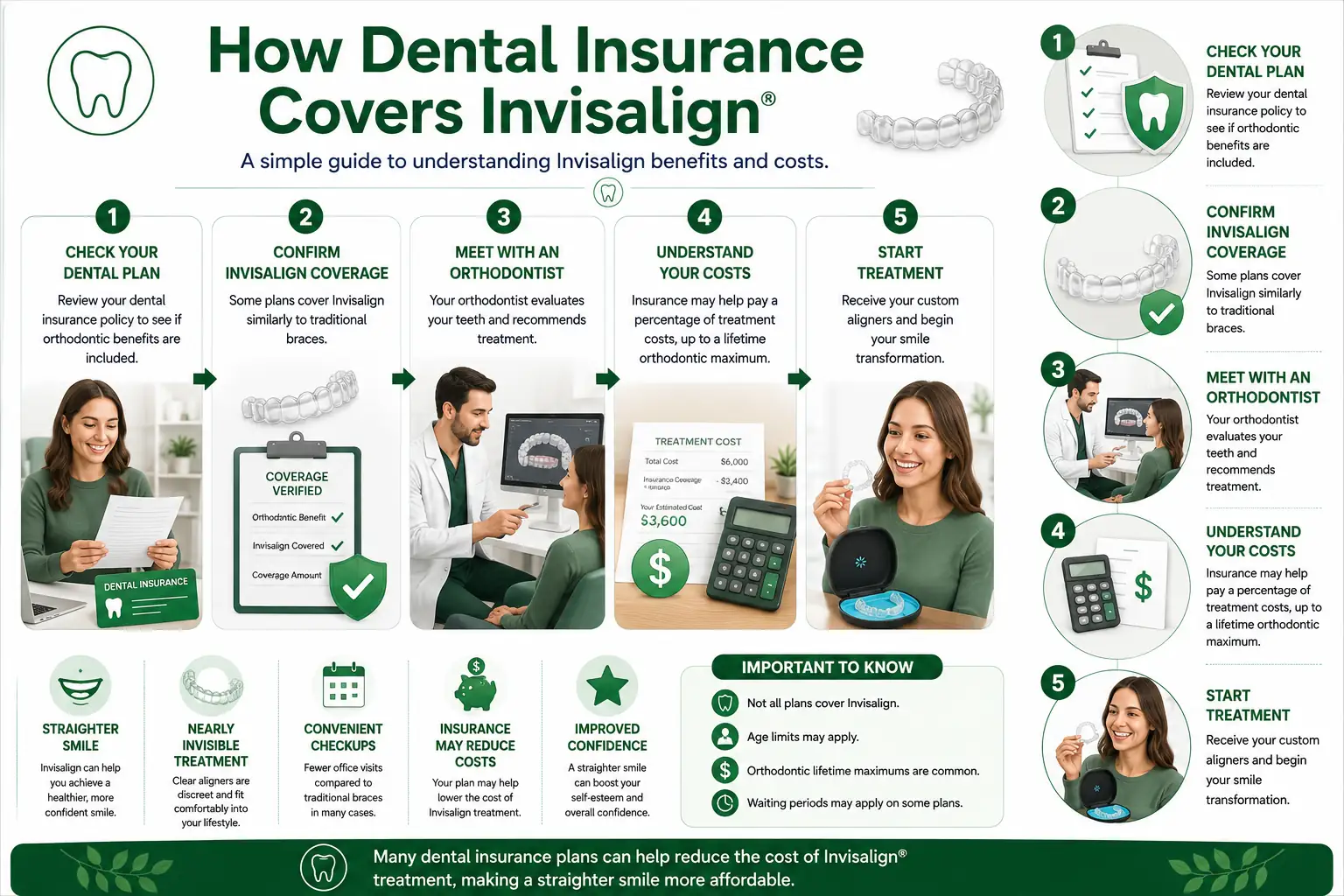
Important to Know:
- Orthodontic benefits do not automatically include every clear aligner system.
- Adult and dependent eligibility may differ.
- A lifetime orthodontic maximum may limit the complete plan payment.
- Treatment started before eligibility may be limited or excluded.
Invisalign, Clear Aligners, and Braces at a Glance
These terms are related, but they are not exactly the same.
| Term | What it generally describes | What to verify with the plan |
|---|---|---|
| Invisalign | A specific brand of clear aligner treatment | Whether the brand or prescribed clear aligner treatment is eligible |
| Clear aligners | A broader category of removable orthodontic trays | Covered appliance types, provider rules, procedure codes, and exclusions |
| Traditional braces | Fixed brackets, wires, and related components | Orthodontic eligibility, provider network, lifetime maximum, and member charges |
| Retainers | Appliances used after or during orthodontic treatment | Whether initial retainers, replacements, and repairs are included or billed separately |
| Refinements | Additional aligners used when further tooth movement is planned | Whether they are included in the original case fee or evaluated separately |
| Replacement aligners | New trays supplied after loss, damage, or another qualifying event | Whether replacements are covered, discounted, limited, or excluded |
| Follow-up visits | Appointments used to monitor and adjust treatment | Whether visits are included in the case fee or separately reported |
| Transfer treatment | Continued treatment after changing providers | Treatment-in-progress rules, remaining benefits, network, and payment schedule |
These are general treatment descriptions. The written treatment plan, procedure codes, provider information, orthodontic benefit schedule, and exclusions determine how the plan evaluates a specific case.
Invisalign
Invisalign is one brand within the larger clear aligner category.
Some plans may mention clear aligners generally. Others may refer to orthodontic treatment without naming specific products. That is why you should ask about the exact treatment being recommended.
Clear Aligners
Clear aligners are removable trays that gradually shift teeth.
From an insurance perspective, a plan may treat clear aligners as orthodontic treatment. But coverage can still depend on plan language, provider network, age limits, and medical necessity.
Traditional Braces
Traditional braces use brackets and wires to move teeth.
Some plans may clearly cover braces but be less clear about aligners. Others may treat both similarly if orthodontic benefits are included. The AAO states that dental plans with orthodontic coverage usually cover traditional braces and clear aligners equally, but each plan is different and accepted coverage varies.
For the separate braces-focused plan comparison, read Best Dental Insurance for Braces in 2026.
How Orthodontic Benefit Rules May Affect Clear Aligner Treatment
Dental plans may evaluate Invisalign and other clear aligner systems under an orthodontic benefit.
The existence of that benefit does not establish that every person, provider, appliance, or treatment stage is eligible.
Eligible Members and Age Rules
Confirm which covered members qualify for orthodontic benefits.
A plan may apply different rules to:
- Children
- Teenagers
- Adult dependents
- Spouses
- Employees or primary policyholders
- Other eligible family members
Ask:
- Whether adult orthodontics are included
- Whether an age limit applies
- Whether treatment must begin before a specified birthday
- Whether benefits continue after the member reaches that age
- Whether dependent status must continue throughout treatment
- What happens if eligibility changes during treatment
Enrollment in the dental plan does not automatically establish eligibility for its orthodontic benefit.
Eligible Treatment and Appliance Type
Ask whether the plan includes the exact treatment recommended by the dentist or orthodontist.
Confirm how the policy evaluates:
- Invisalign
- Clear aligner therapy
- Other branded aligner systems
- Traditional braces
- Ceramic braces
- Lingual braces
- Retainers
- Refinements
- Replacement aligners
- Transfer treatment
- Relapse treatment
Do not rely only on a statement that “orthodontics are covered.”
For a broader orthodontic comparison, review Best Dental Insurance for Braces: What to Compare Before Enrolling.
Lifetime Orthodontic Maximum
An orthodontic benefit may use a lifetime maximum that limits the total amount the plan may pay for one covered person.
Confirm:
- The lifetime maximum
- The amount currently available
- Whether benefits were used previously
- Whether previous braces or aligner treatment reduces the remaining amount
- Whether retainers, refinements, or replacement appliances reduce the maximum
- Whether the maximum applies separately from the regular dental annual maximum
- Whether changing plans affects previously used benefits
The printed lifetime maximum does not reveal how much the plan will pay for the current treatment.
How the Plan May Schedule Payments
A plan may divide orthodontic payments across the expected treatment period instead of paying the complete benefit when treatment begins.
Ask whether payment depends on:
- The treatment-start date
- Periodic claims
- Progress submissions
- Continued enrollment
- Continued eligibility
- The remaining lifetime benefit
- The treatment schedule
- The provider’s continued network participation
Also ask what happens if:
- Employment ends
- The employer changes dental plans
- The patient changes providers
- The dependent reaches an age limit
- Treatment lasts longer than expected
- Coverage ends before treatment is complete
Effective Date and Waiting Period
The policy effective date and the orthodontic eligibility date may be different.
Confirm:
- The policy effective date
- Whether orthodontics has a separate waiting period
- The exact date the orthodontic benefit becomes available
- Whether previous comparable coverage may affect the waiting period
- Which documents are required
- Whether the decision will be provided in writing
A policy may be active while Invisalign or another orthodontic treatment remains ineligible.
HealthCare.gov confirms that separate Marketplace dental plans may apply waiting periods to adult services and that pediatric dental availability does not require families to purchase the offered coverage.
For the separate timing rules, read Dental Insurance Effective Date: When Does Coverage Start? and How Waiting Periods Work in Dental Coverage.
Dentist or Orthodontist Network
Confirm the exact treating provider and office location.
Ask:
- Whether the provider participates in the exact dental plan and network
- Whether participation is current
- Whether new patients are accepted through the plan
- Whether treatment must be provided by an orthodontist
- Whether a general dentist may provide eligible aligner treatment
- Whether a referral is required
- How out-of-network treatment is evaluated
- Whether changing providers affects the remaining benefit
A dental office may accept insurance from a company without participating in every plan or network offered by that company.
For more detail, review In-Network vs Out-of-Network Dental Insurance.
Treatment-in-Progress Provisions
A new plan may limit or exclude treatment that began before the policy effective date or orthodontic eligibility date.
Ask how the contract defines the beginning of treatment.
The relevant event may involve:
- The initial orthodontic records
- Digital scanning
- Acceptance of the treatment plan
- Ordering the aligners
- Delivery of the first aligner
- Placement of attachments
- The first active treatment visit
- Another event defined by the contract
Do not assume that treatment begins only when the first aligner is worn.
Obtain the applicable definition and decision in writing whenever possible.
For the separate framework for orthodontic treatment already underway when coverage changes, read Dental Insurance and Treatment Already in Progress.
Previous Orthodontic Treatment
Previous orthodontic care may affect eligibility or the remaining lifetime benefit.
Ask whether the plan considers benefits previously paid for:
- Braces
- Invisalign
- Another clear aligner system
- Retainers
- Retreatment
- Relapse correction
- Treatment under a previous employer plan
- Treatment under another policy from the same insurer
Ask the insurer or plan administrator to confirm the amount remaining for the covered person.
Preauthorization and Predetermination
Preauthorization and predetermination are distinct processes.
A plan may require preauthorization before treatment begins. A predetermination or pretreatment estimate may instead provide an advance estimate of potential benefits.
Ask:
- Which process applies
- Whether it is required or optional
- Which records must be submitted
- Whether photographs, X-rays, scans, diagnosis, procedure codes, or a treatment plan are required
- How long the response remains valid
- Whether a new review is required when treatment changes
Neither process necessarily guarantees final payment.
Eligibility, remaining benefits, provider status, continued enrollment, and treatment details can change before a claim is processed.
ADA distinguishes preauthorization from predetermination and explains that an advance response can change when eligibility or remaining benefits change.
For the full pretreatment-review framework, read Dental Insurance Predetermination vs Preauthorization: What’s the Difference?
Clinical Documentation and Insurance Eligibility
The dental professional determines whether Invisalign, another clear aligner system, braces, or a different treatment is clinically appropriate.
The plan determines whether the recommended treatment is eligible under the contract.
A clinical recommendation does not override:
- An age restriction
- An appliance exclusion
- A provider-network rule
- A waiting period
- A treatment-in-progress provision
- A lifetime maximum
- Another benefit limitation
Do not reduce the comparison to whether the treatment is “medical” or “cosmetic.”
Ask which covered-service definitions, documentation requirements, exclusions, and procedure codes apply to the actual case.
How the Coverage Source Can Affect Orthodontic Benefits
Orthodontic benefits may differ according to how the dental coverage is obtained.
Employer-Sponsored Dental Coverage
Review:
- Employee and dependent eligibility
- Adult orthodontic eligibility
- Age limits
- The employee and dependent premiums
- Employer contributions
- The provider network
- Waiting periods
- Lifetime orthodontic maximums
- Treatment-in-progress provisions
- Continued-enrollment requirements
- What happens when employment or coverage ends
Use the current Summary Plan Description, certificate of coverage, orthodontic benefit schedule, enrollment materials, and provider directory.
Individual or Family Dental Insurance
A directly purchased policy may:
- Include orthodontic benefits
- Offer orthodontics only through selected products
- Exclude orthodontics
- Restrict benefits to selected ages or dependents
- Use a particular provider network
- Apply waiting periods or treatment-in-progress rules
Confirm that the final policy applies to the correct applicant, dependent, ZIP code, effective date, network, and orthodontic option.
Marketplace Dental Coverage
Marketplace dental coverage is treated differently for adults and children.
Pediatric dental coverage must be available for children age 18 or younger, but this does not mean every available plan includes Invisalign, braces, or another orthodontic treatment.
Adult dental coverage is not an essential health benefit, and adult orthodontic benefits are not automatically included.
A separate Marketplace dental plan may be purchased only while purchasing Marketplace health coverage and may apply waiting periods to adult services.
How to Verify Clear Aligner Benefits Step by Step
Step 1: Obtain the Written Treatment Plan
Ask the dentist or orthodontist for:
- The diagnosis
- The recommended treatment
- The clear aligner brand or system
- Procedure codes
- The provider’s name
- The office location
- The expected treatment period
- The proposed treatment-start date
- The complete treatment fee
- Services included in the case fee
- Services billed separately
Ask separately about:
- Initial records
- Scans
- Attachments
- Refinements
- Replacement aligners
- Retainers
- Repairs
- Follow-up visits
- Transfer treatment
Step 2: Identify the Exact Policy and Network
Confirm:
- The complete plan name
- The orthodontic network
- The policy effective date
- The benefit period
- The covered person’s eligibility
- The treating provider’s participation
Contact both the insurer and the dental or orthodontic office.
Step 3: Verify Orthodontic Eligibility
Ask:
- Does the plan include orthodontic benefits?
- Is the covered person eligible?
- Does an age or dependent-status rule apply?
- Is adult orthodontics included?
- Is the recommended clear aligner treatment eligible?
- Are Invisalign and other aligner systems evaluated differently?
Step 4: Confirm the Available Lifetime Benefit
Ask:
- What lifetime orthodontic maximum applies?
- How much has already been used?
- How much remains?
- Do previous braces or aligner benefits reduce it?
- Do retainers, refinements, or replacement aligners reduce it?
- Does the plan use another orthodontic limit?
Request the available amount in writing when possible.
Step 5: Review Effective Dates and Treatment-in-Progress Rules
Confirm:
- The policy effective date
- The orthodontic eligibility date
- The waiting period
- How the plan defines the beginning of treatment
- Whether scanning or ordering aligners counts as treatment already started
- Whether prior coverage changes the rule
Do not begin nonurgent treatment based only on a general coverage summary.
Step 6: Use the Correct Advance-Review Process
Ask whether the plan requires:
- Preauthorization
- Predetermination
- A pretreatment estimate
- A referral
- Clinical records
- X-rays or photographs
- Digital scans
- A written diagnosis
- Procedure codes
- The complete treatment plan
Review the written response for:
- Treatment eligibility
- Provider requirements
- Waiting periods
- Lifetime maximums
- Benefits previously used
- Exclusions
- Missing documentation
- Continued-enrollment requirements
Step 7: Estimate the Patient Responsibility
Ask the office to identify:
- The complete treatment fee
- The amount recognized by the plan
- The deductible
- Copay or coinsurance
- Expected plan payment
- Amounts above the orthodontic maximum
- Noncovered services
- Out-of-network charges
- Retainer costs
- Refinement costs
- Replacement-aligner costs
- Expected patient responsibility
The result remains an estimate rather than a guarantee of final payment.
Step 8: Keep the Records
Keep copies of:
- The policy
- The orthodontic benefit schedule
- The provider-directory information
- Written provider confirmation
- The treatment plan
- Procedure codes
- Clinical records submitted
- The preauthorization or predetermination response
- Written benefit verification
- The treatment estimate
- The payment agreement
- Claims
- Explanation of Benefits statements
- Written insurer responses
Record the date, representative, contact method, and information provided during important conversations.
Other Ways to Manage Clear Aligner Treatment Costs
If dental insurance is expected to cover only part of clear aligner treatment, ask the orthodontic office for a complete written estimate showing the treatment fee, expected insurance benefit, payment schedule, and estimated patient responsibility.
Other payment options may include an orthodontic-office payment arrangement, third-party financing, eligible health spending accounts, a dental savings or discount program, or care through a dental school or orthodontic residency program when available. These options are separate from dental insurance and can have their own eligibility, provider, cost, and payment rules.
If more than one orthodontic treatment option is clinically appropriate, discuss those options with the treating professional before comparing insurance benefits.
For the broader insurance-cost framework, read Dental Insurance Costs Explained.
For the difference between insurance and a discount membership, read Dental Insurance vs Dental Savings Plans.
A payment method can change how orthodontic treatment is financed, but it does not change whether the dental plan considers the treatment eligible for orthodontic benefits.
Comparison Errors to Avoid
Assuming Orthodontic Coverage Includes Every Aligner System
Verify the exact brand, treatment type, procedure codes, and contract language.
Assuming Adult Benefits Apply to Every Enrolled Adult
Enrollment in the dental plan does not automatically establish adult orthodontic eligibility.
Looking Only at the Lifetime Maximum
The lifetime maximum does not reveal the premium, deductible, payment schedule, provider fees, previously used benefits, exclusions, or final patient responsibility.
Beginning Treatment Before Checking Treatment-in-Progress Rules
Scanning, ordering aligners, delivering the first trays, or another event may count as the beginning of treatment under the contract.
Treating Preauthorization as Guaranteed Payment
Eligibility, provider status, remaining benefits, continued enrollment, and treatment details can change before claims are processed.
Checking Only the Insurance Company Name
Confirm the exact plan, network, provider, and office location.
Assuming Pediatric Dental Availability Guarantees Orthodontics
Marketplace rules require pediatric dental coverage to be available, not that every plan include Invisalign or other orthodontic treatment.
Choosing Treatment Only by Insurance Payment
The clinical decision should reflect the diagnosis and professional recommendation, not only the size of the benefit.
Questions to Ask Before Clear Aligner Treatment
| Question | Why It Matters |
|---|---|
| Does the plan include orthodontic benefits? | Enrollment in a dental plan does not automatically include orthodontic coverage |
| Is the person receiving treatment eligible? | Child, dependent, adult, spouse, and employee eligibility may differ |
| Is the recommended clear aligner system eligible? | Orthodontic coverage does not automatically include every brand or appliance |
| Is adult orthodontic treatment included? | A plan may cover eligible dependents while excluding adults |
| Is the treating provider in the exact network? | Provider participation can affect eligibility and patient costs |
| What waiting period applies? | The policy may be active before orthodontic benefits become available |
| How does the plan define treatment in progress? | Scanning, ordering aligners, delivering trays, or another event may establish the treatment-start date |
| What lifetime orthodontic maximum applies? | The printed maximum may be reduced by benefits used previously |
| How much of the lifetime benefit remains? | Previous braces, aligners, retainers, or other orthodontic payments may affect the available amount |
| How does the plan schedule payments? | Benefits may be divided across treatment and depend on continued enrollment |
| Are retainers and refinements included? | These services may be included in the case fee, evaluated separately, limited, or excluded |
| Are replacement aligners covered? | Lost or damaged trays may create separate charges |
| Is preauthorization required? | A mandatory review may need to occur before treatment begins |
| Is predetermination available? | An estimate may clarify potential benefits without guaranteeing final payment |
| What is the estimated patient responsibility? | The final comparison should include premiums, treatment fees, benefit limits, and noncovered services |
Documents to Keep Before Treatment
Keep copies of:
- The diagnosis and written treatment plan
- The clear aligner brand or system
- The procedure codes
- The proposed treatment-start date
- The complete treatment fee
- The services included in the case fee
- Separate fees for scans, retainers, refinements, or replacements
- The policy or certificate of coverage
- The orthodontic benefit schedule
- The exclusions and limitations
- Provider-directory information
- Written confirmation of provider participation
- The waiting-period provisions
- The treatment-in-progress provisions
- Written confirmation of the remaining lifetime benefit
- The preauthorization or predetermination response
- The office payment agreement
- Financing or discount-program terms
- Claims and Explanation of Benefits statements
- Written answers received from the insurer or plan administrator
Record the date, representative, contact method, and source of every important benefit confirmation.
How to Interpret the Clear Aligner Coverage Comparison
Dental insurance does not provide one universal answer for Invisalign or other clear aligner treatment.
The useful comparison is whether a specific plan provides meaningful orthodontic benefits for the exact person, treatment, provider, and treatment dates involved.
A plan may deserve closer consideration when:
- The covered person is eligible for orthodontic benefits
- The recommended clear aligner treatment is included
- Adult or dependent eligibility matches the patient’s circumstances
- The dentist or orthodontist participates in the exact network
- The effective date and waiting period fit the treatment schedule
- Treatment-in-progress rules do not create an unexpected exclusion
- The available lifetime orthodontic benefit has not already been used
- The payment schedule and continued-enrollment requirements are understood
- Retainers, refinements, replacement aligners, and follow-up services are addressed clearly
- The expected plan payment reasonably justifies the premium and remaining patient costs
A plan may deserve less consideration when:
- Clear aligner treatment is excluded
- Adult orthodontics are not included for the patient
- The preferred provider does not participate
- The waiting period extends beyond the planned treatment date
- Treatment has already begun under the plan’s definition
- Previous orthodontic benefits substantially reduce the remaining maximum
- Continued enrollment creates uncertainty during treatment
- Important services are excluded from the orthodontic case
- The expected payment is limited compared with the premium and patient responsibility
The comparison should use the complete treatment fee rather than only the lifetime orthodontic maximum.
Keep the clinical and insurance decisions separate. The dental professional determines which treatment methods are clinically appropriate. The dental plan determines whether the selected treatment qualifies for benefits under the contract.
When you are ready, compare dental plans using the same patient, provider, treatment, timing, benefit, and cost criteria for every option.
AAO explains that clear aligners may be appropriate for some, but not all, orthodontic conditions, while ADA guidance emphasizes that benefit rules and advance reviews remain controlled by the specific plan.
Helpful Resources
- Dental Plans Guide
- Dental Insurance Coverage for Common Procedures
- Dental Insurance for Braces
- How Waiting Periods Work in Dental Coverage
- No Waiting Period Dental Insurance
- Dental Insurance vs Dental Savings Plans
- In-Network vs Out-of-Network Dental Insurance
- Individual vs Family Dental Plans
- Dental Insurance Costs Explained
- Dental Plan Comparison Checklist
- Compare Dental Plans
- Dental Insurance Learning Center
Frequently Asked Questions
Does dental insurance cover Invisalign?
Some dental plans may provide benefits for Invisalign when the policy includes orthodontic coverage and the treatment satisfies the plan’s eligibility rules.
Coverage depends on the patient, provider, treatment type, effective date, waiting period, lifetime maximum, and other contract terms.
Is Invisalign the same as every clear aligner system?
No.
Invisalign is a specific brand. Clear aligners are a broader category of removable orthodontic appliances.
A plan may evaluate different brands or systems differently.
Does orthodontic coverage automatically include Invisalign?
No.
A plan may include traditional braces while excluding selected clear aligner systems, limiting eligible providers, or applying different member charges.
Confirm the exact treatment recommended by the dental professional.
Does adult orthodontic coverage automatically include Invisalign?
No.
The plan must include adult orthodontic benefits, and the recommended clear aligner treatment must satisfy the applicable covered-service, provider, age, and documentation rules.
What is a lifetime orthodontic maximum?
A lifetime orthodontic maximum is the total amount the plan may pay for one covered person under the applicable contract.
Benefits paid for previous braces, aligners, retainers, or related orthodontic services may reduce the amount remaining.
Can a new dental plan cover Invisalign treatment already in progress?
It depends on the treatment-in-progress provisions.
The plan may exclude existing treatment, provide limited transfer benefits, or use another method described in the contract.
Ask how the plan defines the treatment-start date and obtain the decision in writing.
Does preauthorization guarantee payment?
Not necessarily.
Preauthorization and predetermination are distinct processes. Eligibility, remaining benefits, provider status, continued enrollment, and treatment details can change before claims are processed.
What should I verify first?
Begin with the written treatment plan.
Then confirm the patient’s eligibility, exact aligner system, provider network, effective date, waiting period, treatment-in-progress rules, remaining lifetime maximum, payment schedule, and estimated patient responsibility.
Sources
- American Association of Orthodontists — Clear Aligners
- American Association of Orthodontists — Clear Aligner Therapy
- American Association of Orthodontists — Adult Orthodontics
- American Dental Association — Pre-Authorizations
- American Dental Association — An Introduction to Dental Benefits
- American Dental Association — Typical Dental Plan Benefits and Limitations
- HealthCare.gov — Dental Coverage in the Marketplace
- U.S. Department of Labor — Plan Information
- Internal Revenue Service — Publication 502: Medical and Dental Expenses
HealthCare.gov confirms that pediatric dental coverage must be available in the Marketplace but does not require every dental product to include orthodontic treatment; adult dental coverage is not an essential health benefit. IRS Publication 502 includes braces among examples of dental treatment but states that its itemized-deduction rules do not by themselves determine FSA reimbursement eligibility.
About the Author
Maria Dumitru is the Founder and Content Editor of Dental Coverage Hub. She researches and edits educational content designed to help U.S. consumers understand dental insurance terms, compare plan features, and verify important information before enrolling.
Learn more about our standards in the Editorial Policy and How We Review Dental Plans.
This article provides general educational information and is not dental, medical, legal, tax, financial, or personalized insurance advice. Clinical recommendations, clear aligner eligibility, provider networks, effective dates, waiting periods, lifetime orthodontic maximums, treatment-in-progress provisions, advance-review requirements, costs, and availability can vary by plan, provider, treatment, and location. Review the official documents and consult the appropriate dental professional, insurer, employer, plan administrator, account administrator, or other qualified professional for information specific to your situation.

Explore Dental Coverage for Common Procedures
Clear aligner treatment can be affected by orthodontic eligibility rules, timing provisions, lifetime benefit limits, provider networks, and pretreatment requirements. Use our broader procedure coverage guide to understand how dental insurance may evaluate common types of treatment and what to verify before care begins.