

🟢 Beginner-Friendly
🟢 Dental Plan Basics
🟢 Updated 2026

Dental Insurance Basics: How Plans, Costs, and Coverage Work
Learn dental insurance basics, including how plans work, what they may cover, and which costs and limitations to check. Explore detailed guides to coverage dates, plan rules, and claims.
Written and researched by Maria Dumitru.
Founder and Content Editor at Dental Coverage Hub
Last reviewed: October 2026
Quick Answer: What Is a Dental Plan?
A dental plan sets out how dental benefits are provided, which services may qualify, and what costs remain your responsibility.
Dental insurance can help pay for eligible care, but it does not automatically cover every recommended procedure or the dentist’s full charge. Benefits depend on the specific plan, provider arrangements, and applicable limitations.
Before relying on coverage, confirm:
- When coverage becomes active
- Whether your dentist participates in the exact plan
- Which benefits apply to the care you need
- What you may have to pay
- Which restrictions could affect payment
Dental savings or discount plans are different: they offer access to participating providers’ discounted fees rather than insurance claim benefits.
Key Takeaways
- The specific plan matters more than the insurer’s name. Review the documents for the exact option available to you.
- Active coverage does not make every service payable. Waiting periods, exclusions, and other limitations may still apply.
- Provider access affects how you use coverage. Verify the individual dentist, location, and network.
- Premiums are only part of the cost. Consider what you would pay when receiving care.
- Insurance and discount arrangements work differently. Identify the product before comparing its benefits and charges.
In This Guide
How Dental Insurance Plans Work
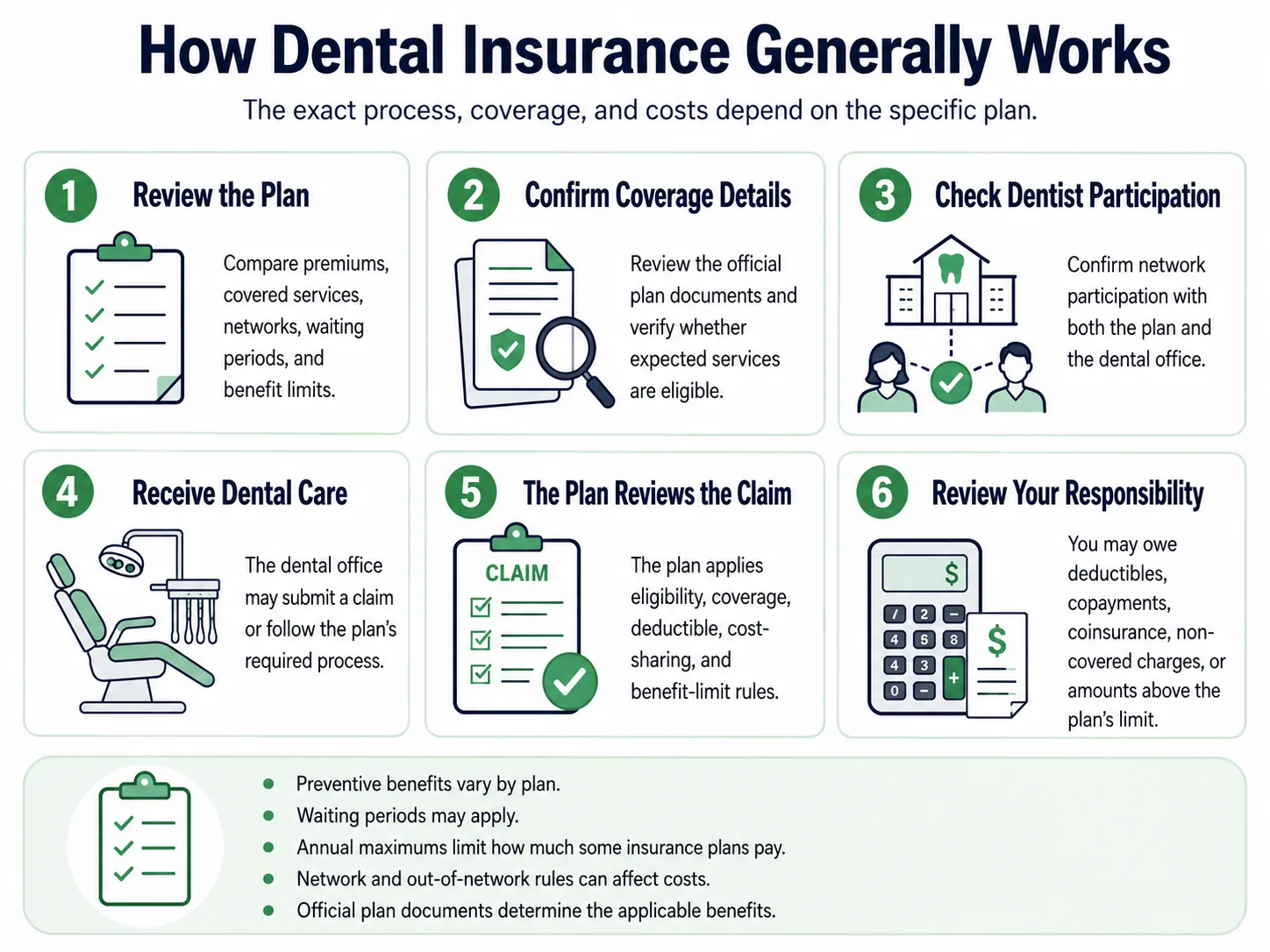
Dental insurance combines enrollment requirements, covered-service rules, provider arrangements, and payment provisions.
You or your employer may pay a premium to maintain coverage. When you receive dental care, the plan’s terms determine whether a benefit applies and how your share of the cost is calculated.
Before You Receive Care
Confirm that your coverage is active and check the proposed treatment against the plan’s benefits.
Ask the dental office for the planned procedures, then verify relevant network requirements, restrictions, and expected patient charges with the plan. For significant treatment, ask whether an advance review is available or required.
A treatment recommendation explains the care your dentist proposes. It does not, by itself, establish what insurance will pay.
When Benefits Are Processed
Under many dental insurance arrangements, the dental office or patient submits a claim. The plan evaluates the services using the applicable coverage terms and determines any payment and patient responsibility.
Other arrangements, such as DHMO plans, may use contracted service fees and a different payment structure. Check how your particular plan handles treatment charges.
Which Documents Should You Review?
Start with:
- The policy, certificate of coverage, or applicable employer plan documents
- The benefit schedule and relevant exclusions or limitations
- Enrollment confirmation and the coverage effective date
- The directory for the exact provider network
A short benefits summary can help you get oriented. Use the detailed documents and plan administrator to resolve questions that the summary does not answer.
Common Types of Dental Plans
Plan types differ in provider access and payment arrangements. The label is a starting point; check the specific contract.
Dental PPO Plans
A preferred provider organization uses a network of contracted dentists. Check both in-network terms and any out-of-network benefits before choosing a provider.
DHMO or Dental HMO Plans
These plans generally require care through participating offices. Review dentist-selection requirements and the schedule of patient charges for covered services.
Indemnity Dental Plans
Indemnity plans generally allow patients to choose their dentist and pay benefits according to the contract. The plan’s allowance may differ from the dentist’s charge.
Other Plan Arrangements
You may also encounter EPO plans, point-of-service options, or scheduled-benefit arrangements. Ask which providers you can use and how payment is determined.
Dental Savings or Discount Plans
These are not dental insurance. Members pay participating dentists at the arrangement’s discounted fees; the program does not pay insurance claims.
What Dental Insurance May Cover
Dental plans may organize services into preventive, basic, major, and orthodontic benefits. These categories help explain the benefit structure, but their definitions are not identical across plans.
Check the specific procedure in the benefit schedule rather than relying only on its category.
Preventive and Diagnostic Services
These may include dental examinations, cleanings, and X-rays. Fluoride treatments or sealants may also be included, subject to eligibility and plan restrictions.
Check frequency limits, age requirements, and whether a deductible or other patient charge applies. Preventive care is not automatically unlimited or free under every arrangement.
Basic and Major Services
Plans may include benefits for fillings, extractions, root canals, periodontal treatment, crowns, bridges, or dentures.
The classification can vary. For example, do not assume that every plan places root canal treatment in the same benefit category.
For each proposed procedure, check whether it is included, how the benefit is calculated, and which restrictions apply. Confirm implant benefits separately rather than assuming that coverage for other tooth-replacement services includes implants.
Orthodontic Services
Orthodontic benefits may be included, offered separately, or unavailable.
If benefits are available, review age eligibility, waiting periods, lifetime limits, and rules for treatment already underway. Coverage for children does not automatically establish coverage for adults.
Review Each Procedure Separately
A treatment plan may involve several services with different benefit rules. Coverage for one part does not establish coverage for the entire course of care.
Use Dental Insurance Coverage for Common Dental Procedures to find the guide relevant to your proposed treatment.
Common Dental Insurance Costs
Your premium keeps coverage in place, but it does not represent everything you may pay for dental care.
Not every plan uses every cost feature below. Review the structure of the specific arrangement.
| Cost or benefit term | What it means | What to check |
|---|---|---|
| Premium | The recurring charge for coverage | Your contribution, payment frequency, and any employer contribution |
| Deductible | An amount you may need to pay before certain benefits apply | Which services it affects, when it resets, and any individual or family rules |
| Copayment | A specified patient charge for a covered service | The charge listed for the particular procedure |
| Coinsurance | Your percentage share of the fee recognized under the plan | Which fee the percentage applies to and whether a deductible applies first |
| Annual benefit maximum | A limit on what the plan pays toward applicable services during a benefit period | The limit, remaining benefits, reset date, and any services treated separately |
| Other patient charges | Amounts you may owe beyond ordinary cost sharing | Noncovered services, exhausted benefits, and possible charges above an out-of-network allowance |
An Annual Maximum Is Not a Cap on Your Spending
An annual benefit maximum limits the plan’s payment. It does not establish the most you could personally spend on dental care.
If applicable benefits are exhausted, you may still owe treatment charges. Review Dental Insurance Annual Maximums Explained for the details.
Consider Premiums and Treatment Costs Together
For budgeting, consider your premium contribution alongside the patient charges associated with expected care.
A lower premium alone does not establish a lower total cost. Provider arrangements, covered services, and benefit restrictions also affect the amount you may pay.
For a fuller explanation of these terms and how they interact, read Dental Insurance Costs Explained.
Explore Dental Insurance Basics: Beginner Guides
Start with these guides to understand common plan structures, the difference between insurance and discount arrangements, preventive benefits, and how to evaluate the usefulness of coverage.
🟩 PPO vs HMO Dental Plans
Explore differences in dentist access, network requirements, and patient costs. Learn which details to verify beyond the plan label.
🟩 Dental Insurance vs Dental Savings Plans
Understand how insurance benefits differ from membership-based discounts. Compare how each arrangement handles provider access and treatment charges.
🟩 Preventive Dental Care
Review how exams, cleanings, and other preventive services may fit into dental benefits. Check the frequency, age, and coverage rules that can affect their use.
🟩 Is Dental Insurance Worth It?
Consider premiums, expected care, available benefits, and limitations when evaluating what coverage may offer in your situation.
Important Dental Plan Rules to Understand
Different plan rules answer different questions. Start with the issue you need to resolve, then use the relevant guide to identify what to check in your plan documents.
Coverage Start Dates and Waiting Periods
Separate the date your coverage starts from the timing rules for a particular benefit.
- Dental Insurance Effective Date: When Does Coverage Start? — Confirm when the coverage itself becomes active
- How Waiting Periods Work in Dental Coverage — Check when benefits subject to a waiting period may become available
- No Waiting Period Dental Insurance: What to Verify Before Enrolling — Review what the advertised feature includes and which other restrictions still need checking
Coverage Restrictions and Existing Dental Problems
If you already need dental care, identify the specific provision that may affect the proposed treatment.
- Dental Insurance Exclusions and Limitations: What to Check Before Enrolling — Identify services and circumstances restricted by the contract
- Dental Insurance and Existing Dental Problems: What to Check Before Enrolling — Review coverage questions when a dental problem exists before enrollment
- Missing Tooth Clauses in Dental Insurance: What to Check Before Enrolling — Check provisions affecting replacement of a tooth that was already missing
Repeated Services, Replacement Work, and Unfinished Treatment
These situations require different checks. Choose the guide that matches the treatment history.
- Dental Insurance Frequency Limits Explained: What to Check Before Treatment — Check how often a recurring service may receive a benefit
- Dental Insurance Replacement Rules Explained: What to Check Before Replacing Dental Work — Review how the age and history of existing dental work may affect replacement benefits
- Dental Insurance and Treatment Already in Progress — Identify what to verify when treatment has begun and coverage changes
Advance Reviews, Claims, and Benefit Decisions
Choose the guide that matches your stage in the process, from reviewing proposed treatment to understanding or questioning a claim decision.
- Dental Insurance Predetermination vs Preauthorization: What’s the Difference? — Understand the differences between advance review processes and what each response establishes
- How Dental Insurance Claims Work: From Treatment to Your EOB — Follow the process from claim submission through the plan’s response
- How to Read a Dental Insurance EOB: Payments, Adjustments, and Patient Responsibility — Interpret the explanation issued after claim processing
- Dental Insurance Claim Denied? How to Review the Decision and Appeal — Review a denial, identify its stated reason, and check the available next steps
Coverage Under Two Dental Plans
If you have two dental plans, check how their benefits interact before estimating what you will owe.
- Can You Have Two Dental Insurance Plans? Coordination of Benefits Explained — Review primary and secondary plan responsibilities and the coordination rules to verify
When You Are Ready to Compare Dental Plans
Once you understand the basic terms, compare the options you can actually enroll in using the same expected care and coverage period.
Organize the information around:
- Enrollment eligibility and coverage dates
- Access to your dentists and specialists
- Benefits for expected treatment
- Your premium contribution and treatment costs
- Restrictions that could affect those benefits
Use Compare Dental Plans for the detailed comparison process.
Keep the information together with the Dental Plan Comparison Checklist, and mark unanswered questions for confirmation with the insurer or plan administrator.
Explore Procedure Coverage and Guidance for Your Situation
Some questions start with a treatment recommendation. Others begin with a change in employment, household circumstances, or access to coverage. Choose the guide that matches your starting point.
If You Need a Particular Dental Procedure
Use Dental Insurance Coverage for Common Dental Procedures to explore coverage questions for fillings, extractions, root canals, crowns, tooth replacement, orthodontics, and other treatments.
Start with the procedure your dentist has recommended. If treatment involves several services, review the relevant guides separately and confirm how your plan evaluates each part.
If Your Coverage Needs or Circumstances Are Changing
Use Dental Insurance by Life Stage and Work Situation to find guidance for your household, employment, or coverage transition.
The collection includes guides for families, young adults, college students, seniors, retirees, self-employed individuals, and small business owners. It also addresses part-time work, changing or losing a job, divorce, leaving parent coverage, the end of COBRA, and options for adults with limited income.
Choose the situation that applies to you, then review the eligibility, timing, and coverage questions it raises.
Our Recommendation
Begin with the question you need to answer: understanding a plan, checking a benefit rule, reviewing proposed treatment, or preparing for a coverage change.
Use the relevant guide to identify what to ask. Then check the documents for your exact plan and confirm unresolved coverage questions with the insurer or plan administrator. Ask the dental office about the proposed procedures, treatment timing, and estimated charges.
If you are choosing between available plans, use Compare Dental Plans to organize the comparison around your expected care, provider access, and total costs.
Helpful Resources
Frequently Asked Questions
Where should I start if I am new to dental insurance?
First identify the coverage available to you and the exact plan documents. Learn how the plan handles provider access, covered services, premiums, and treatment charges. Then use the detailed guides on this page for questions about timing, restrictions, or claims.
Does dental insurance pay for every treatment my dentist recommends?
No. A treatment recommendation and an insurance benefit decision serve different purposes. Check whether the proposed procedure qualifies under your plan and which exclusions, limits, or patient charges apply.
Does active coverage mean I can use every benefit immediately?
No. Confirm the coverage effective date separately from any waiting period or service-specific restriction. Active enrollment does not establish that every proposed procedure is immediately eligible for payment.
What is the difference between PPO and DHMO dental plans?
PPO plans use contracted provider networks and may include out-of-network benefits. DHMO plans generally require care through participating offices and use a schedule of patient charges. Review the exact network, dentist-selection requirements, and payment rules for each option.
Are dental savings plans the same as dental insurance?
No. Dental savings or discount plans provide access to specified discounts through participating providers. Members pay the applicable treatment charges; the program does not pay insurance claim benefits.
Is an annual benefit maximum the most I could pay?
No. An annual benefit maximum limits what the plan pays toward applicable services during a benefit period. Your own spending may include premiums, cost sharing, noncovered care, and charges after applicable benefits are exhausted.
Can I keep my current dentist when I enroll?
That depends on the plan and the dentist’s participation. Confirm the individual dentist and office location under the exact network. If the dentist is outside that network, check whether benefits are available and how your charges would be determined.
Which documents should I review before relying on coverage?
Review the policy or certificate of coverage, benefit schedule, exclusions, enrollment confirmation, and applicable provider information. For employer coverage, also review the relevant employer plan documents, including the Summary Plan Description when applicable. Ask the insurer or plan administrator to clarify unresolved questions.
Sources
About the Author
Maria Dumitru is the Founder and Content Editor of Dental Coverage Hub. She researches and develops educational resources designed to help U.S. consumers understand dental insurance plans, coverage rules, costs, provider networks, and comparison factors.
Learn more about our standards in the Editorial Policy and How We Review Dental Plans.
Dental Coverage Hub is an independent educational publisher, not an insurer or insurance broker. This guide does not confirm coverage or guarantee payment for any service.
This guide provides general educational information for U.S. consumers. It is not medical, legal, financial, or personalized insurance advice. Benefits, eligibility, costs, and enrollment rules vary by state, employer, insurer, and specific plan. Verify current details in the applicable plan documents and with the insurer or plan administrator. Discuss treatment decisions with your dental professional.

Put the Basics Into Practice
Use what you have learned to review the plans available to you. Compare their benefits, provider access, costs, and restrictions using the same expected dental needs. Start with the comparison guide, then use the checklist to record plan details and questions that still need confirmation.